The National Oil Corporation has called for urgent intervention after unidentified individuals closed the Hamada to Zawiya pipeline, the second shutdown of the line in five weeks and the latest in a run of disruptions that threaten Libya’s highest output in more than a decade.
| ~1.4m b/d
Libya’s current oil output, according to Reuters |
1.44m b/d
Crude output in June 2026, the highest since 2013 (NOC) |
$95m
Losses the NOC attributed to September’s Sharara pipeline closure |
Libya’s National Oil Corporation (NOC) said on Thursday that unidentified individuals had entered a crude oil receiving station near the Zawiya refinery in western Libya and closed the valve on the pipeline that carries crude from the Hamada and Tahara oilfields to Zawiya, cutting production at both fields.
The station belongs to the Arabian Gulf Oil Company (AGOCO), an NOC subsidiary. The NOC warned that “the continuation of this shutdown will lead to the loss of volumes of crude oil production,” with a direct impact on oil revenue, and urged the relevant authorities “to intervene immediately to reopen the valve and secure the site.” It did not identify those responsible or say how much output had been lost.
Both fields lie in the Ghadames basin in north-western Libya. According to figures previously published by the NOC, Hamada can produce about 50,000 barrels per day (b/d) under stable conditions, while Tahara was brought back into production in 2022 with a target of 40,000 b/d. Zawiya, west of Tripoli, hosts a refinery with capacity of about 120,000 b/d and a crude export terminal.
Second closure in five weeks
The same line was shut on 15 September, when members of the Petroleum Facilities Guard (PFG), the force that protects oil installations and currently falls under the Defence Ministry, closed a valve and halted output at Hamada and Tahara. The guards demanded to be placed “financially and administratively under the National Oil Corporation” and threatened cuts at the Wafa, Al-Khamsa and El Feel fields, followed by a full shutdown if their demands were not met. The NOC raised the possibility of declaring force majeure and described the stoppages as “a devastating blow to the national economy.”
On 21 September, an armed group closed a valve on the pipeline linking the Sharara field, which has capacity of 300,000 to 320,000 b/d, to Zawiya, sharply reducing output at Libya’s largest field. The NOC later put the losses from that closure at $95 million. Thursday’s statement did not link the latest closure to any group, although guards at oil facilities have been pressing for higher wages as part of wider protests in the sector, according to Anadolu Agency.
Disruption at a high point for production
The shutdowns come as Libyan output is close to its highest level in more than a decade. The NOC reported crude production of 1,438,560 b/d in June, plus 49,163 b/d of condensate, the highest rate since 2013, and output is currently about 1.4 million b/d. The corporation has set a longer-term goal of 2 million b/d and is rolling out digital and automation programmes across its fields. In February, Libya awarded five exploration blocks in its first licensing round in 17 years, with Chevron, Eni, QatarEnergy and Repsol among the winners.
Higher prices have lifted revenue. The NOC reported gross oil revenue of $2.82 billion in April and nearly $4 billion in May, the highest monthly intake in more than a decade, according to local energy reports cited by Global Finance.
A dispute over where the money goes
The latest closure coincides with a public dispute over oil revenue. The Central Bank of Libya said it received only $361 million in oil revenue in the first two weeks of October, while the NOC said it transferred $1.2 billion over the same period, a gap of $839 million. The NOC said the lower figure reflects the central bank’s practice of deducting the cost of fuel imports from crude revenue. The central bank did not dispute that directly but said it welcomes independent audits of its records.
Oil provides about 90% of state revenue, and Libya remains divided between the UN-backed Government of National Unity in Tripoli and a rival administration in the east. In April, the rival eastern and western legislatures agreed a framework to unify public spending, the country’s first consolidated budget since 2013.
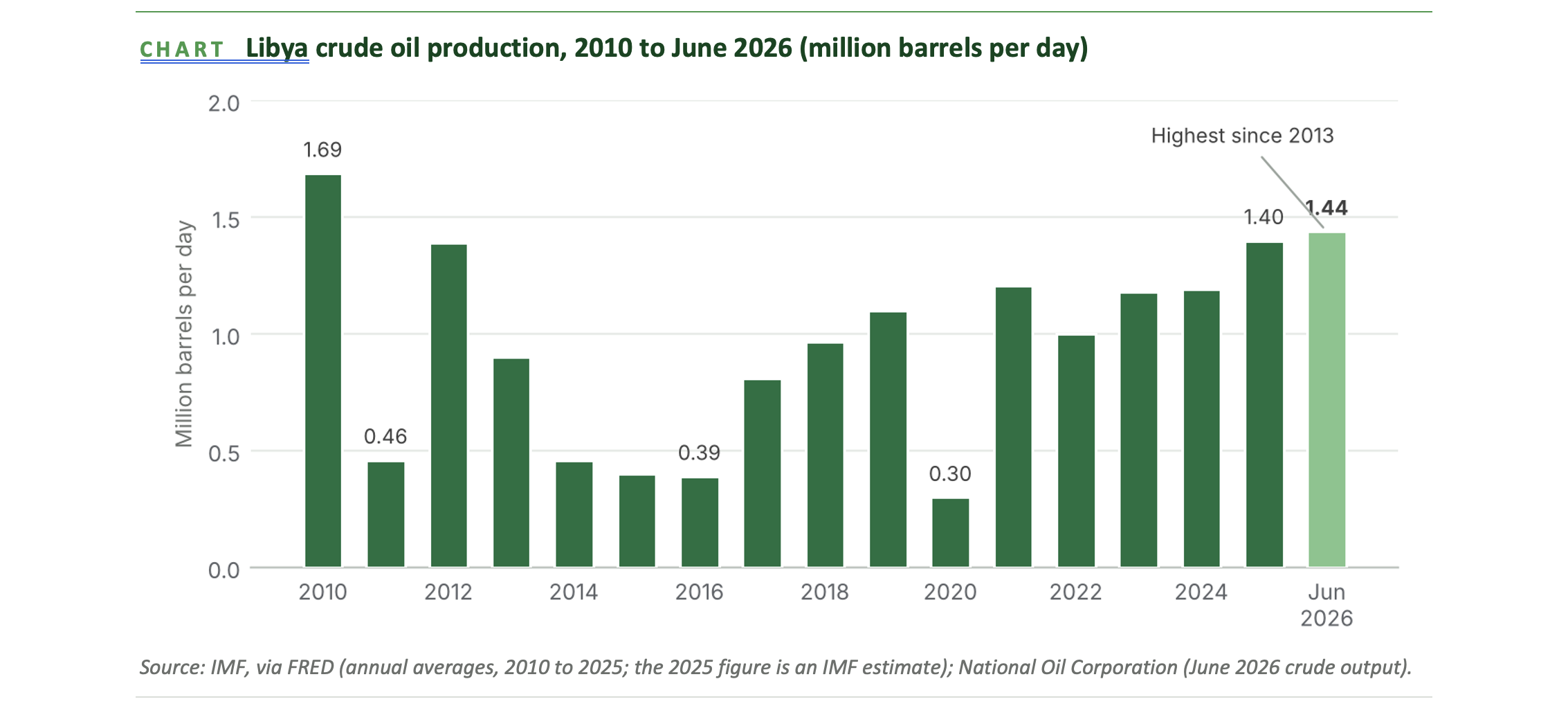
CHART Libya crude oil production, 2010 to June 2026 (million barrels per day)
Source: IMF, via FRED (annual averages, 2010 to 2025; the 2025 figure is an IMF estimate); National Oil Corporation (June 2026 crude output).
Analysis
Libya’s constraint is control, not geology. The country holds Africa’s largest proven oil reserves, estimated at about 48 billion barrels, and has shown that it can restore output quickly when politics allows: production rose from about 300,000 b/d in 2020 to about 1.2 million b/d in 2021. The chart shows the reverse as well. The collapses of 2011, 2014 to 2016 and 2020 were driven by conflict and by blockades of fields, pipelines and terminals, not by depletion.
The valve has become a bargaining tool. The September and October closures follow a long-established pattern in which groups with physical access to infrastructure shut it down to press demands over pay, institutional status or revenue. The PFG’s demand to move under the NOC goes to the heart of who controls oil security. Until that question is settled, the western pipeline network that carries crude from Hamada, Tahara and Sharara to Zawiya will remain exposed.
The revenue dispute is a quieter but related risk. In April, only $1.91 billion of $2.82 billion in gross oil revenue reached the central bank after deductions for fuel imports and settlements, according to the reports cited by Global Finance, meaning roughly a third was netted off before reaching the treasury. In a country with rival administrations and an oil-dependent budget, disagreements over that accounting can quickly become disputes over legitimacy. Such disputes have triggered production shutdowns before, most recently during the 2024 crisis over the central bank’s leadership.
High prices raise the stakes on both sides. With Brent above $112 per barrel on Thursday and Gulf supply routes under threat, Libya’s light, sweet crude, shipped across the Mediterranean to European refiners, is in strong demand. Every day of lost output now costs the state more, which increases the leverage of those who control the valves and the cost to the authorities of leaving disputes unresolved.
Investor Outlook
- Upstream investors: The February licence awards and the 2 million b/d goal point to genuine opportunity, but project economics should assume periodic, unscheduled shutdowns. This year’s disruptions have centred on western fields that depend on pipelines to Zawiya.
- Oilfield service companies: Field rehabilitation in the Sirte and Murzuq basins continues to generate work, but payment cycles depend on oil revenue reaching the central bank, which the current dispute calls into question.
- Crude buyers and traders: Libyan grades remain attractive to Mediterranean refiners while Gulf supply is disrupted, but cargoes linked to western pipelines carry higher interruption risk.
- Watchpoints: How quickly the valve is reopened; any force majeure declaration; a decision on the status of the Petroleum Facilities Guard; and an independent reconciliation of the NOC and central bank revenue figures.