Borr Drilling’s Prospector 5 jack-up sank late on Saturday on BW Energy’s Dussafu licence off southern Gabon while preparing to drill new production wells. Officials say five people remain unaccounted for, while Reuters, citing three sources, reports that one worker has died and four are missing. BW Energy has halted output at its MaBoMo platform, and the government has ordered a technical investigation.
| 115
People on board when the rig sank |
110
Accounted for safely, according to the companies and the government |
5
Unaccounted for in the official count; Reuters reports one of them dead |
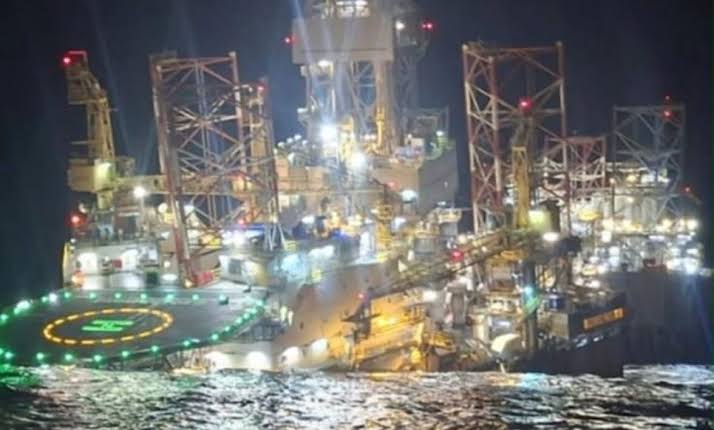
A jack-up drilling rig sank off the coast of Mayumba in southern Gabon late on Saturday, 24 October, with 115 people on board. The Prospector 5, owned and operated by Borr Drilling, went down at about 20:37 local time on the Dussafu Marine licence operated by BW Energy, near the company’s MaBoMo production platform. The rig was being jacked up ahead of a planned drilling campaign and had not yet started drilling.
Borr Drilling and BW Energy said on Sunday that 110 people had been safely accounted for and five remained unaccounted for, and that search and rescue operations were continuing. Reuters, citing three sources, reported that one of the five, an Indian national, had been found dead, and that the four still missing were three Gabonese nationals and one other expatriate. Sylvain Mayabi Binet, secretary-general of Gabon’s National Organisation of Petroleum Employees (ONEP), gave the same account. The government had not confirmed the death and continued to report five people missing. One local outlet, Infos Gabon, reported that three of the missing had been found alive, but neither the authorities nor the companies had confirmed this at the time of writing.
Borr Drilling said preliminary information indicates that the rig “experienced a punch through event during preload activities,” which led to a loss of stability and the rig sinking. Gabon’s Ministry of Petroleum and Gas said initial information from the operators pointed to subsidence of the seabed under one of the rig’s legs. A punch-through occurs when a jack-up leg, loaded heavily during preloading to test the seabed, breaks through a firmer layer of soil into weaker ground beneath and drops suddenly, tilting the hull. The ministry said the exact cause will be established by a technical investigation.
Government response
Petroleum and Gas Minister Clotaire Kondja activated a crisis unit bringing together the ministry, the Navy, the National Parks Agency, state oil company Gabon Oil, BW Energy and Borr Drilling. He ordered the Navy to reinforce search and rescue at sea and ordered a technical investigation into the causes of the accident and any responsibilities, with conclusions to be made public. A support arrangement for the families has been set up with BW Energy.
President Brice Clotaire Oligui Nguema, who was in Barcelona, said on Facebook that he was following the search “hour by hour” and instructed the government to mobilise all state resources, starting with the Navy. “The State expects full cooperation from the operator, on searches and investigation,” he wrote. “The Gabonese have the right to know what happened. Those who work at sea for our country must be able to do so safely.” (Quotes translated from French.) He said he had spoken to the chief executive of BW Energy.
Borr Drilling chief executive Bruno Morand said: “We are deeply concerned for those who remain unaccounted for and everyone affected by this incident.” The company said its immediate priority was supporting the search and the welfare of all personnel, and it has opened an information line for families.
The rig and its mission
The Prospector 5 is a Friede & Goldman JU-2000E self-elevating rig built in 2014, rated for water depths of up to 400 feet (about 122 metres) and wells up to 35,000 feet deep. The Dussafu licence has an average water depth of about 116 metres. In April, Borr announced a binding letter of award from BW Energy for the rig, covering a firm scope of four wells with a minimum duration of 320 days and options for a further 220 days, starting in the third quarter of 2026.
The four wells make up MaBoMo Phase 2, BW Energy’s next growth step on Dussafu. Each well was expected to produce about 5,000 barrels per day (b/d), adding about 20,000 b/d of gross output, with first oil targeted for early 2027. BW Energy has also been appraising the Northwest Hibiscus discovery, which could add up to a further 10,000 b/d if fast-tracked, Offshore Magazine reported in July.
What the field was producing
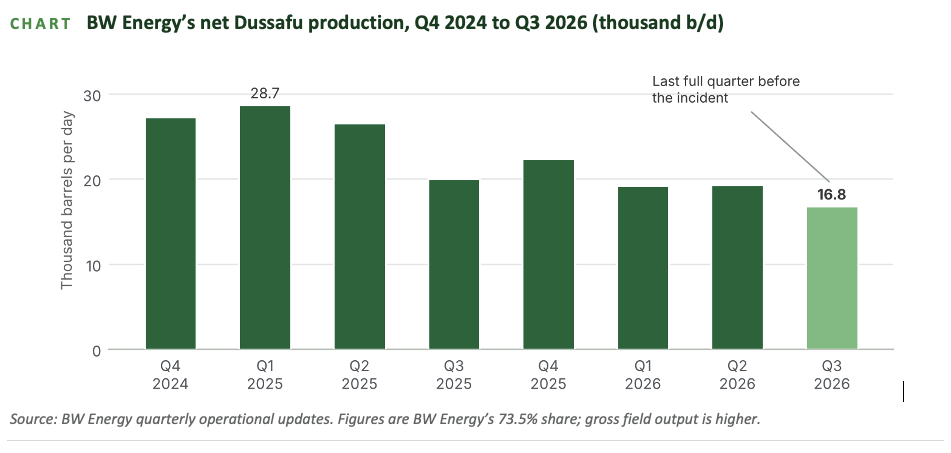
The rig itself was not producing oil. The production at stake comes from the MaBoMo wellhead platform, which handles wells on the Hibiscus field and sends their output through a 20 km pipeline to the BW Adolo floating production vessel, which also receives oil from the Tortue field. Dussafu produced about 33,200 b/d gross on average in 2025. BW Energy’s net share, from its 73.5% interest, averaged 16,800 b/d in the third quarter of 2026, down from 28,700 b/d in the first quarter of 2025, partly because of pump failures and maintenance. That implies gross output of roughly 23,000 b/d, about a tenth of Gabon’s crude production, which OPEC secondary sources put at 207,000 b/d in July.
BW Energy said production at MaBoMo had been shut down “under standard procedure during the drilling preparations,” and reported no damage to the facility and no accidental discharge of harmful substances to the sea. Panoro Energy, which holds 17.5% of the licence, confirmed that production had been halted. Gabon Oil Company holds the remaining 9%. BW Energy has not said when output will restart or how much production is affected.
The ministry said no harmful substances had been discharged, but pollution-response resources remain deployed to protect the coastline and Mayumba National Park, a coastal and marine park known for its turtle nesting beaches.
KEY NUMBERS Prospector 5 and the Dussafu licence
| Rig | Prospector 5, Friede & Goldman JU-2000E jack-up, built 2014; owned and operated by Borr Drilling |
| Rating | Water depth up to 400 ft (about 122 m); drilling depth up to 35,000 ft |
| Activity when it sank | Jacking and preloading ahead of drilling; no well had been started |
| Contract | Four firm wells for BW Energy, minimum 320 days, plus 220 days of options; start Q3 2026 |
| Planned output from the wells | About 5,000 b/d each, about 20,000 b/d gross in total, first oil early 2027 |
| Dussafu output | About 33,200 b/d gross in 2025; BW Energy net 16,800 b/d in Q3 2026 (about 23,000 b/d gross) |
| Licence partners | BW Energy 73.5% (operator), Panoro Energy 17.5%, Gabon Oil Company 9% |
| Gabon crude output | 207,000 b/d in July 2026 (OPEC secondary sources) |
Gross Dussafu output for Q3 2026 is an AER estimate derived from BW Energy’s reported net share.
Analysis: how the sinking could affect Gabon
The immediate impact is human. Three of the people reported missing are Gabonese, according to Reuters, and the involvement of the oil workers’ union and the President’s public demand for answers mean the investigation will be closely watched. Pressure is likely to grow for tighter oversight of rig moves and site surveys, including geotechnical assessments before jack-ups are installed, and for clearer offshore emergency response standards. Operators should expect more scrutiny of contractor safety records and of marine operations close to producing platforms.
In the short term, the production impact depends on how quickly MaBoMo can restart. The platform was shut as a standard precaution and is reported undamaged, but the rig sank close to the facility. Operators and regulators will need to confirm that the area is safe, that pipelines and risers are intact and that the wreck poses no hazard before production resumes. At roughly a tenth of national output, a prolonged shutdown of Dussafu would show up in Gabon’s monthly production figures and in BW Energy’s results, although the share of Dussafu output that flows through MaBoMo, rather than directly to the Adolo vessel from Tortue, has not been disclosed.
The larger cost may be delay. MaBoMo Phase 2 was BW Energy’s main source of near-term growth on Dussafu, with four wells expected to add about 20,000 b/d from early 2027. Losing the rig contracted to drill them means finding a replacement jack-up and probably repeating site surveys before any rig returns to the location. Gabon’s budget framework assumes crude output rising from 10.80 million tonnes in 2026 to 11.30 million tonnes in 2027, an increase of about 10,000 b/d. A delay to Phase 2 would make that target harder to reach.
Gabon has little fiscal room to absorb lost barrels. Moody’s rates the country Caa2 with a negative outlook, it issued a $920 million seven-year Eurobond in July at a 9.375% coupon, and an IMF staff visit in September ended without an agreement. The 2027 draft budget puts oil revenue at about XAF 1,013 billion ($1.8 billion) and assumes a price of $70 a barrel. The state earns from Dussafu through royalties, its share of profit oil and Gabon Oil Company’s 9% interest, so the timing of the restart and of Phase 2 matters for public finances.
The incident also tests Gabon’s offshore operating environment at a time when the government is seeking new upstream investment. A transparent and timely investigation, as the President has promised, would limit reputational damage. A slow or opaque process would raise perceived risk for contractors, insurers and investors working in the country.
Investor Outlook
- BW Energy: Third-quarter results on 29 October will be the first opportunity to quantify the impact. Company-wide 2026 guidance of about 23,000 b/d net was set before the incident. The key questions are the MaBoMo restart date, the availability of a replacement rig and the revised Phase 2 schedule.
- Borr Drilling: The loss removes a rig from its fleet and the Phase 2 contract from its backlog. Insurance cover, liability and the investigation’s findings on the punch-through will determine the financial effect. Its shares closed at $4.40 on Friday, before the sinking.
- Panoro Energy and Gabon Oil Company: As 17.5% and 9% partners, both are exposed to the shutdown and to any delay to Phase 2 in proportion to their interests.
- Gabon’s sovereign credit: A short shutdown would have a limited fiscal effect. A long delay to Phase 2 would weigh on the 2027 production and revenue assumptions in a budget with little margin.
- Watchpoints: The final casualty count; the restart of MaBoMo; the findings of the technical investigation; any new requirements for rig installation and site surveys; and the timing of a replacement rig.