With Brent trading about $51 above the price assumed in Angola’s 2026 budget, the government expects oil to average close to $90 a barrel this year. Higher import costs, however, are pushing the fuel subsidy bill towards 3.8 trillion kwanzas as officials prepare a 2027 budget built on a much lower price.
| $61
Oil price assumed in Angola’s 2026 budget |
~$90
Government’s expected average oil price for 2026 |
3.8tn Kz
Projected 2026 fuel subsidy bill (about $4.16bn), against 1.7tn budgeted |
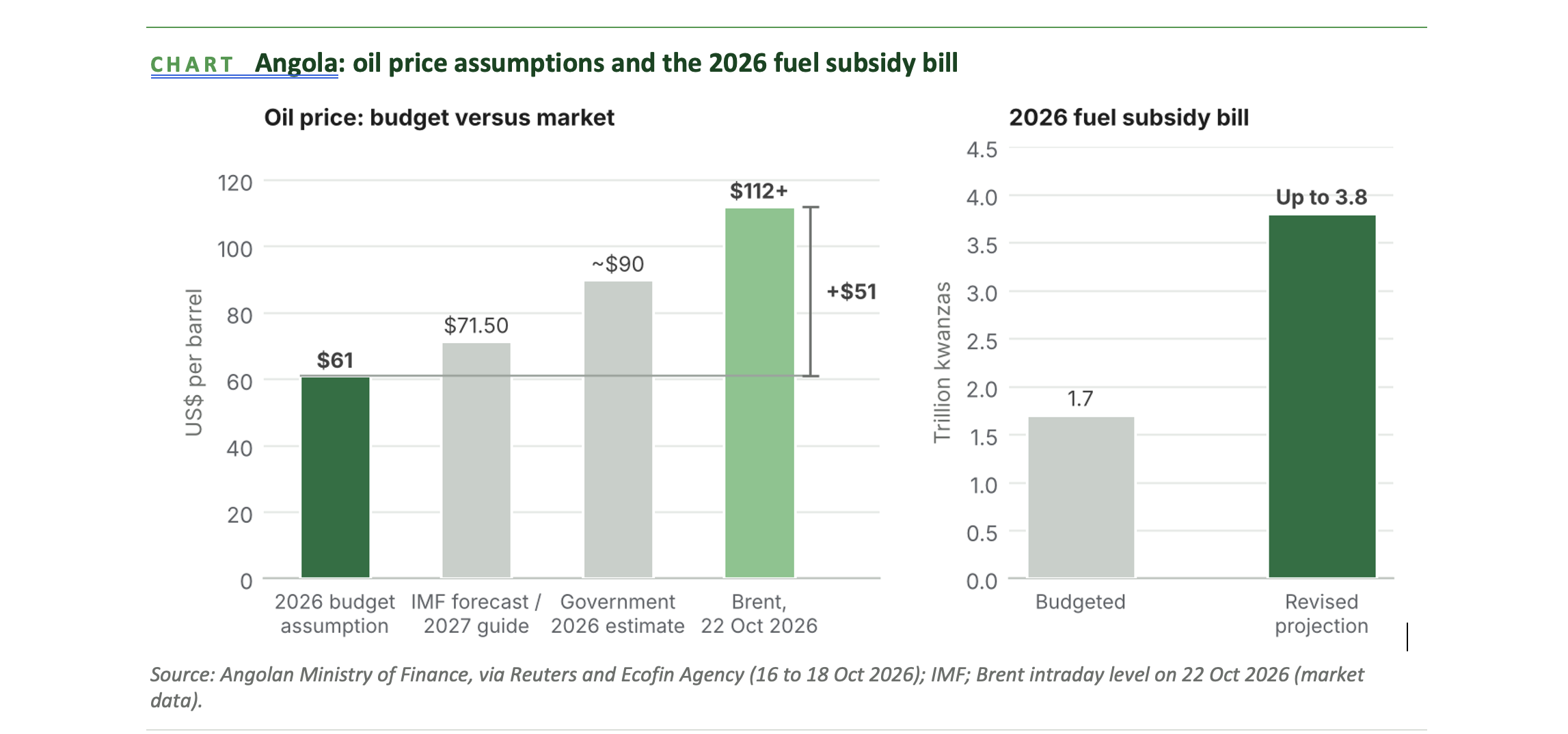
Brent crude rose above $112 a barrel on Thursday, its highest level since May, leaving international prices about $51 above the $61 assumed in Angola’s 2026 budget. Officials now expect oil to average close to $90 a barrel this year, Secretary of State for Finance and Treasury Ottoniel dos Santos said in interviews with Reuters and Lusa on 16 October, on the sidelines of the IMF and World Bank annual meetings in Bangkok.
The same rally is driving up the cost of keeping fuel cheap at home. Dos Santos said spending on fuel subsidies could reach up to 3.8 trillion kwanzas ($4.16 billion) in 2026, more than twice the 1.7 trillion kwanzas initially budgeted. The revised figure is equivalent to 11.4% of the initial 2026 budget of 33.24 trillion kwanzas, and the increase alone, about 2.1 trillion kwanzas ($2.3 billion), is equivalent to 6.3%.
“We need to move not only with the subsidies removal, but also with the diversification of our economy,” dos Santos told Reuters. He said the government would continue to phase out subsidies slowly for now, and could move faster if the impact on the most vulnerable proved smaller than forecast.
Import costs drive the bill
Angola imports most of the refined fuel it consumes, so its subsidy bill tracks international product prices. Sonangol has put the cost of imported gasoline at nearly $1,700 a tonne, up from about $700 at the end of 2025, according to local media. Domestic pump prices remain well below import parity despite increases since 2023: the IMF estimates that diesel rose from $0.16 to $0.43 a litre between 2023 and 2025, against an international reference price of about $1.20. The Fund estimates that subsidies still cost nearly 1.7% of GDP in 2025, and that savings from the reform fell short of expectations by about 0.7 percentage points of GDP, partly because the kwanza depreciated.
Price increases have proved politically sensitive. A 33% rise in diesel prices in July 2025 was followed by a taxi drivers’ strike and protests across several provinces in which 22 people were killed, according to official figures at the time. The government’s Kwenda cash-transfer programme, which helps offset the impact of reform on poorer households, now covers more than 1.4 million registered rural families.
Output holding just above 1 million b/d
On the supply side, Angola is producing close to the 1.05 million barrels per day (b/d) assumed in the budget. Output rose to 1.045 million b/d in September, a four-month high, from 1.006 million b/d in August, according to government data reported by Quantum Commodity Intelligence, after averaging about 1.032 million b/d in the first half. In his final state of the nation address on 15 October, President João Lourenço said: “The sector has been implementing measures aimed at ensuring production above 1 million barrels per day.” Oil Minister Diamantino Azevedo has said Angola aims to keep output above that level until at least 2027. Angola left OPEC in January 2024.
Lourenço said public debt had fallen to 51.2% of GDP from 115.9% in 2020, and that the non-oil sector “has become the main driver of the economy,” which grew 5.3% in the first quarter on 6.2% non-oil growth. Angola raised about $4 billion through two Eurobond issues in March and May, which dos Santos said covered most of this year’s financing needs, while oil-backed debt fell from $7.37 billion at the end of 2025 to $6.83 billion in June, according to the Finance Ministry.
A cautious 2027 budget
The 2027 budget is due to be submitted by the end of October. Dos Santos said its oil price assumption would not differ significantly from the IMF’s forecast of $71.50 a barrel, with production projected at 1.045 million b/d, unchanged from 2026. Any further bond issuance will depend on the new budget. The government is also working to open its domestic bond market to foreign investors. “Some investors think that the capital account is still closed,” dos Santos said.
CHART Angola: oil price assumptions and the 2026 fuel subsidy bill
Source: Angolan Ministry of Finance, via Reuters and Ecofin Agency (16 to 18 Oct 2026); IMF; Brent intraday level on 22 Oct 2026 (market data).
Analysis
For Angola, a higher oil price is a mixed blessing. Every dollar above the $61 assumption raises export earnings and fiscal revenue, but because the country imports most of its fuel at world prices and sells it at regulated prices, the same rally raises the subsidy bill. The additional 2.1 trillion kwanzas of subsidy spending absorbs a large share of the windfall. In April, when the government was planning on about $80 a barrel, the extra revenue was estimated at about 3.2 trillion kwanzas. At close to $90 the gross gain will be larger, but the net benefit is much smaller than the headline price gap suggests.
Building the 2027 budget around $71.50 is prudent. If Gulf supply normalises and prices fall, revenue will fall but so will the subsidy bill; if prices stay high, Angola will again outperform its budget. The weaker point is the reform path. With the 2025 protests in recent memory and a general election due in 2027, at the end of President Lourenço’s second and final term, the government has limited room for large price increases. That leaves the budget exposed to import costs for as long as subsidies remain.
On production, the task is now to hold the line. Output has eased from an average of about 1.13 million b/d in 2024, the year Angola left OPEC, to about 1.03 million b/d in the first half of 2026, and holding it above 1 million b/d requires continuous investment to offset mature-field decline. The government has responded with fiscal incentives, including additional tax incentives approved in June for four blocks operated by Chevron, TotalEnergies and BP, and with plans to replace multi-year licensing rounds with faster awards and to open more than 100 mostly onshore blocks. With volumes flat, Angola’s oil revenue depends largely on price, which leaves it exposed when prices fall.
The credit story has improved. A sharp fall in public debt, lower oil-backed borrowing and renewed Eurobond access give Angola more room than it had in previous price cycles. Opening the domestic bond market to foreign investors would widen its funding base further, and the 2027 budget will show whether this year’s windfall is used to reduce borrowing or largely absorbed by the subsidy bill.
Investor Outlook
- Sovereign bondholders: High oil prices support foreign-exchange inflows and debt service. The 2027 budget, due by the end of October, will set the oil price assumption, deficit target and subsidy path that shape the next financing round.
- Upstream investors: New fiscal incentives and faster licensing aim to arrest decline. A government focused on keeping output above 1 million b/d is likely to remain receptive to commercial terms that support new projects.
- Fuel importers and distributors: The pace of subsidy reform is the largest policy variable for downstream margins. Domestic refining, including the Lobito refinery, which was about 26% complete in September and is due in 2029, should reduce import needs over time.
- Currency and local markets: The kwanza has traded at about 912 to 929 per dollar, and gross reserves stood at $15.9 billion at the end of 2025, enough for about 10.5 months of imports, according to BFA. Wider access for foreign investors to local bonds is a development to watch.