Murphy Oil has entered Central Africa with four production sharing contracts covering 10,578 km² offshore Cameroon, signed with the national oil company SNH in Yaoundé on 11 November. The programme is valued at about $200 million over up to seven years and could include eight exploration wells, but the wells fall in optional renewal periods. The deal comes as Cameroon’s oil output and revenues decline.
| $200m
Estimated programme over up to seven years, about CFA112 billion, including optional periods |
Up to 8
Exploration wells, one per block in each of two optional two-year renewals |
10,578 km²
Combined area of the four blocks in the Douala/Kribi-Campo basin |
Murphy Oil Corporation has signed four production sharing contracts (PSCs) with Cameroon for offshore exploration blocks covering 10,578.13 km² in the Douala/Kribi-Campo basin, marking the Houston-based company’s entry into Central Africa. The contracts for the Etinde Exploration, Tilapia, Ntem and Elombo blocks were signed in Yaoundé on Wednesday, 11 November 2026, by Adolphe Moudiki, Administrator-Director General of the Société Nationale des Hydrocarbures (SNH), and Daniel Ray Hanchera, Senior Vice President of Murphy Oil, on behalf of its subsidiary Murphy Cameroon Exploration and Production SASU. Professor Fuh Calistus Gentry, Minister of Mines, Industry and Technological Development, presided over the ceremony.
Murphy will initially hold a 100% working interest in all four blocks and operate them, while SNH has the option to take up to 20% in any future development, the company said. According to SNH’s communiqué, Murphy has committed to a minimum work programme over a maximum of seven years, with a total financial commitment estimated at $200 million, about CFA112 billion, including the optional periods. Murphy said it would work with SNH to further evaluate the exploration potential of the blocks; it gave no date for drilling.
A seven-year programme, with drilling in the later phases
The first three-year period covers the reprocessing of existing seismic data and geological and geophysical studies. It can be followed by two optional two-year renewal periods, each requiring one exploration well per contract, which would mean up to eight wells across the four blocks if both renewals are taken up on every block. Camer.be, citing the programme presented at the ceremony by Claudine Manga, President of the Permanent Commission for the Negotiation of Oil and Gas Contracts, reported that the firm commitment for the first period is a minimum of $600,000 per block, or $2.4 million in total, and that each well is estimated at $25 million. On that basis, nearly all of the $200 million depends on Murphy electing to enter the renewal periods.
The contracts also set a cost recovery cap of 70% for oil and 85% for gas, a corporate income tax rate of 35%, production bonuses of $1 million to $3 million and training contributions of $110,000 a year during exploration and $250,000 a year during development and production, according to Camer.be. They are governed by Cameroon’s Petroleum Code, Law No. 2019/008 of 25 April 2019. Murphy’s negotiating team was led by Simon Payne, Vice President, Business Development.
CHART Murphy’s Cameroon work programme: firm and optional spending
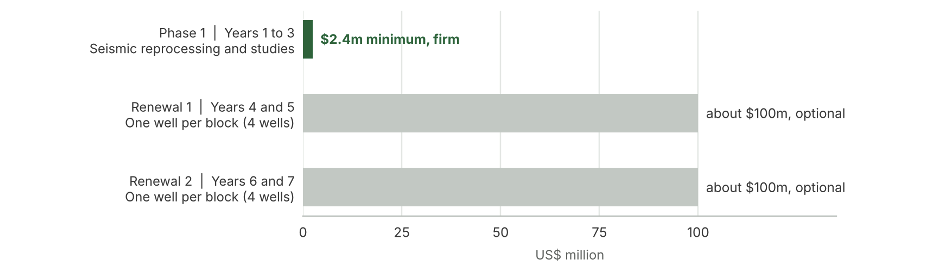
Source: SNH communiqué; Camer.be (12 Nov 2026), citing the programme presented at the signing. Renewal amounts are AER calculations at about $25 million per well.
Part of a wider push by Murphy, and by Cameroon
The Cameroon contracts follow Murphy’s signing on 4 November of two PSCs for the C-10 and Tiof blocks offshore Mauritania, covering about 3.1 million acres, which it operates with a 90% interest while Mauritania’s national oil company SMH holds a 10% carried interest. Murphy has also secured six exploration licences in Zone G offshore Israel and, in June, announced a light oil discovery at the Bubale-1X well offshore Côte d’Ivoire, World Oil reported. The company’s net production was 186,495 barrels of oil equivalent per day in the third quarter of 2026, according to EcoMatin.
For Cameroon, the deal is the largest result so far of SNH’s promotion of nine blocks launched in August 2025. On 14 August 2026, SNH signed a PSC with the UK’s Octavia Energy for the Bolongo Exploration block in the Rio del Rey basin, with a programme of $41 million over seven years. With Murphy’s four blocks, five of the nine now have operators; Ndian River, Bakassi, Bomono and Kombe-Nsepe remain unallocated, Camer.be reported.
Output and revenues in decline
The new acreage comes as Cameroon’s production falls. SNH data show crude output of 19.374 million barrels in 2025, down 9.4% from 21.377 million in 2024, with most output coming from the mature Rio del Rey fields. SNH projects a recovery to 20.8 million barrels in 2026 and 22.1 million in 2027, but S&P Global Ratings expects output to decline from 54,200 barrels per day in 2025 to 52,000 b/d in 2026 and 43,800 b/d in 2028. At the signing, the minister acknowledged that “several of our mature fields are in natural decline” (AER translation).
CHART Cameroon crude output: two outlooks (thousand barrels per day)
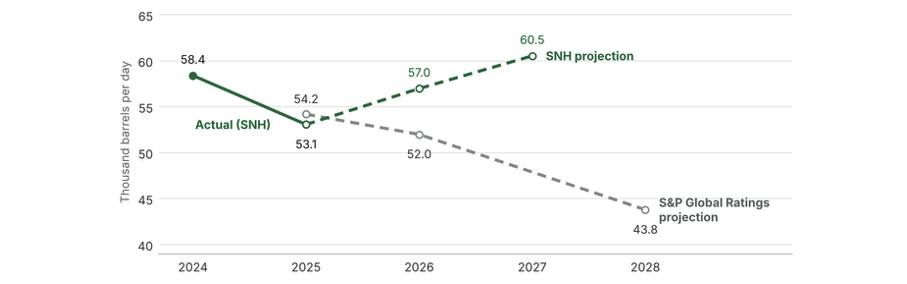
Source: SNH annual output and projections, converted from barrels a year by AER; S&P Global Ratings projections as reported by Camer.be (12 Nov 2026).
Revenues have followed. Business in Cameroon calculated from SNH data that the value of crude sold on behalf of the state fell 20.8% in the first half of 2026 to CFA237.9 billion, as volumes fell 34.3% to 4.635 million barrels, even though the average price rose 60% to $104.15 per barrel. Hydrocarbon exports earned CFA1,055.8 billion in 2025, 34.3% of export revenue and 23.7% less than a year earlier, and cocoa has overtaken oil as Cameroon’s main source of foreign exchange, according to Camer.be. Cameroon also lost its LNG exports when Golar’s Hilli Episeyo floating LNG vessel, with a capacity of 2.45 million tonnes a year, left Kribi in early August after eight years for a new project in Argentina; Financial Afrik reported that the departure left a domestic gas gap of about 24,000 tonnes a year.
KEY TERMS Murphy’s Cameroon production sharing contracts
| Blocks | Etinde Exploration, Tilapia, Ntem and Elombo; Douala/Kribi-Campo basin; 10,578.13 km² (about 2.6 million acres) |
| Signed | 11 November 2026, Yaoundé; SNH and Murphy Cameroon Exploration and Production SASU |
| Interests | Murphy 100% and operator; SNH option of up to 20% in any future development |
| Term | Up to seven years: three-year first period plus two optional two-year renewals |
| Work programme | First period: seismic reprocessing and studies, minimum $600,000 per block; each renewal: one well per block |
| Estimated commitment | About $200 million (CFA112 billion), including optional periods |
| Fiscal terms | Cost recovery cap 70% (oil) and 85% (gas); corporate income tax 35%; production bonuses $1 million to $3 million |
| Legal basis | Petroleum Code, Law No. 2019/008 of 25 April 2019 |
Sources: Murphy Oil Corporation; SNH communiqué via Energies Media; EcoMatin; Camer.be, as reported.
Analysis
Murphy’s entry is a vote of confidence in an under-explored part of Cameroon’s offshore from an operator with deepwater experience, and it gives SNH’s licensing drive a significant name after the loss of Hilli Episeyo. Four of the nine blocks offered in 2025 have gone to a single US company, and the award places four blocks in the same basin under one operator, which can evaluate them together.
The structure is a low-cost option for Murphy. With a firm commitment of about $2.4 million in the first three years, it can screen more than 10,000 km² using existing data before deciding whether to drill. That limits its downside and is common for under-explored acreage, but it means the $200 million headline is contingent. Camer.be noted that SNH’s August 2025 call had asked for at least one well and new 3D seismic in the initial period; the signed terms include neither, suggesting Cameroon accepted lighter early commitments to secure a credible operator.
The timetable is long. If Murphy uses the full first period, the first exploration well would not be required before late 2029 (AER calculation), and any discovery would then need appraisal and development. The contracts will not slow Cameroon’s decline in the near term; that depends on existing operators in the Rio del Rey and Douala basins and on the gap between SNH’s projected recovery and S&P’s projected decline.
Murphy’s strategy is also clear. In two weeks it has taken operated positions in Mauritania, Cameroon and Israel at low entry cost, building on its Côte d’Ivoire discovery. A broad portfolio of low-commitment acreage lets it rank prospects across basins and drill only the best, which means Cameroon’s blocks will compete for capital with Murphy’s other new positions.
Investor Outlook
- Murphy shareholders: The Cameroon position adds large acreage for minimal near-term spending. Its value depends on the first-period studies and on whether Murphy commits to drilling, likely towards the end of the decade.
- SNH and the state: The 20% option applies only after a commercial discovery, so the fiscal benefit is long term. Near-term revenue depends on arresting decline in existing fields and on oil prices.
- Service companies: Near-term work is seismic reprocessing and geological studies. Drilling contracts would follow only if Murphy enters the renewal periods.
- Other explorers: Four blocks from the 2025 round remain open (Ndian River, Bakassi, Bomono and Kombe-Nsepe), and the Murphy and Octavia terms suggest SNH is flexible on initial commitments.
- Watchpoints: Murphy’s first-period findings and any decision to drill; awards of the remaining blocks; SNH’s quarterly production and sales data; Cameroon’s response to its domestic gas gap; and Murphy’s exploration results in Côte d’Ivoire and Mauritania.
Phase-by-phase commitment figures are as reported by Camer.be from the programme presented at the signing, and the $200 million total is SNH’s estimate including optional periods. This article is provided for information purposes only and does not constitute investment advice.