Sasol and the pipeline company ROMPCO have each signed agreements with Mozambique’s state hydrocarbons company ENH to assess a floating LNG import terminal at Inhassoro that would feed the pipeline carrying most of South Africa’s gas. ROMPCO’s chief executive says a joint-development agreement could be signed by January, with commissioning from 2030, as supply from the Pande and Temane fields begins to decline.
| $450m
Project cost cited by ROMPCO’s chief executive, including the FSRU and a spur pipeline |
January
Target date for a ROMPCO–ENH joint-development agreement |
2030
Expected start of commissioning; Pande-Temane supply expected to fall after 2028 |
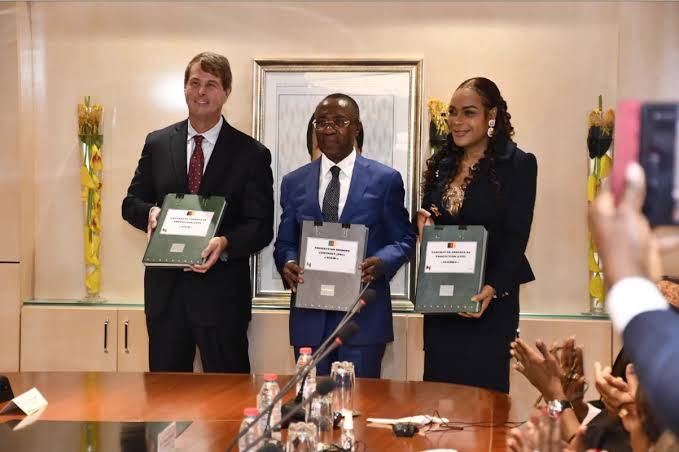
Mozambique’s state hydrocarbons company, Empresa Nacional de Hidrocarbonetos (ENH), signed two agreements in two days last week to move a liquefied natural gas (LNG) import terminal at Inhassoro towards development. On Wednesday, 11 November 2026, Sasol and ENH signed a memorandum of understanding (MoU) to assess the feasibility of an LNG terminal linking Inhassoro and Beira, on the sidelines of the Africa Gas & LNG Summit at the Joaquim Chissano International Conference Centre in Maputo, in the presence of Prime Minister Maria Benvinda Levi. On Thursday, 12 November, ENH Chairman Rudêncio Morais and Mlandzeni Boyce, Chief Executive Officer of the Republic of Mozambique Pipeline Investments Company (ROMPCO), signed a second MoU on the same project.
The project centres on a floating storage and regasification unit (FSRU) moored off Inhassoro, in Inhambane province, close to the Sasol-operated Pande and Temane gas fields and the start of the ROMPCO pipeline. Imported LNG would be regasified and fed through a spur line into the 865 km ROMPCO pipeline, which runs from Temane to Secunda in South Africa and carries most of the country’s gas.
Boyce told Bloomberg on 13 November that ROMPCO aims to conclude and sign a joint-development agreement by January. He put the cost of the project at about $450 million, including the FSRU and the connection to the main pipeline, and said ROMPCO wants to own the spur line and take a stake in the FSRU, with commissioning expected from 2030. The LNG would come from Mozambique’s domestic gas allocation, drawn from projects including TotalEnergies’ developments in the north, which Boyce said would allow South African customers to pay a “reasonable price” below global LNG prices.
The cost estimate differs from ENH’s own. When Morais presented the plan at African Energy Week in Cape Town in October, ENH put the investment at about $250 million for FSRUs at Inhassoro and the Port of Beira and a pipeline into the ROMPCO network, according to Reuters and Ecofin Agency. The difference has not been explained and may reflect a change in scope.
What the agreements cover
Under the ROMPCO MoU, the pipeline company will first carry out due diligence and review the studies that ENH has completed or commissioned. If that assessment is positive, the two companies intend to negotiate a joint-development agreement covering a bankable feasibility study, project planning, commercial and contractual structuring, permitting, and engineering and front-end engineering design (FEED). “Our immediate focus is on establishing the technical, commercial and financial feasibility of the opportunity before considering subsequent investment decisions,” Boyce said. Morais said the agreement “represents Mozambique’s commitment to development and transformation based on natural gas.”
Sasol, which has worked with ENH for more than two decades under a Petroleum Production Agreement and a Production Sharing Agreement signed in 2000, will contribute technical expertise and specialist staff to the feasibility work, Ecofin Agency reported. Sasol has also said that methane-rich gas produced from coal at its Secunda operations could bridge the gap until LNG arrives.
The agreements build on steps taken earlier this year. In April, ENH signed a shareholders’ agreement and a joint development agreement with the power utility EDM, the ports and railways company CFM and the Cahora Bassa hydroelectric company HCB, creating a company, SLIGM, to develop, finance and install the terminal. In August, the government awarded a concession covering FSRU installations at the Port of Beira and at Inhassoro, and the right to build and operate a pipeline linking Inhassoro to the existing pipeline at Temane. A law passed by Mozambique’s parliament in June extended to LNG the requirement that 25% of oil and gas production be reserved for the domestic market, which underpins the plan to source the LNG locally.
DIAGRAM How gas reaches South Africa today, and the proposed LNG route
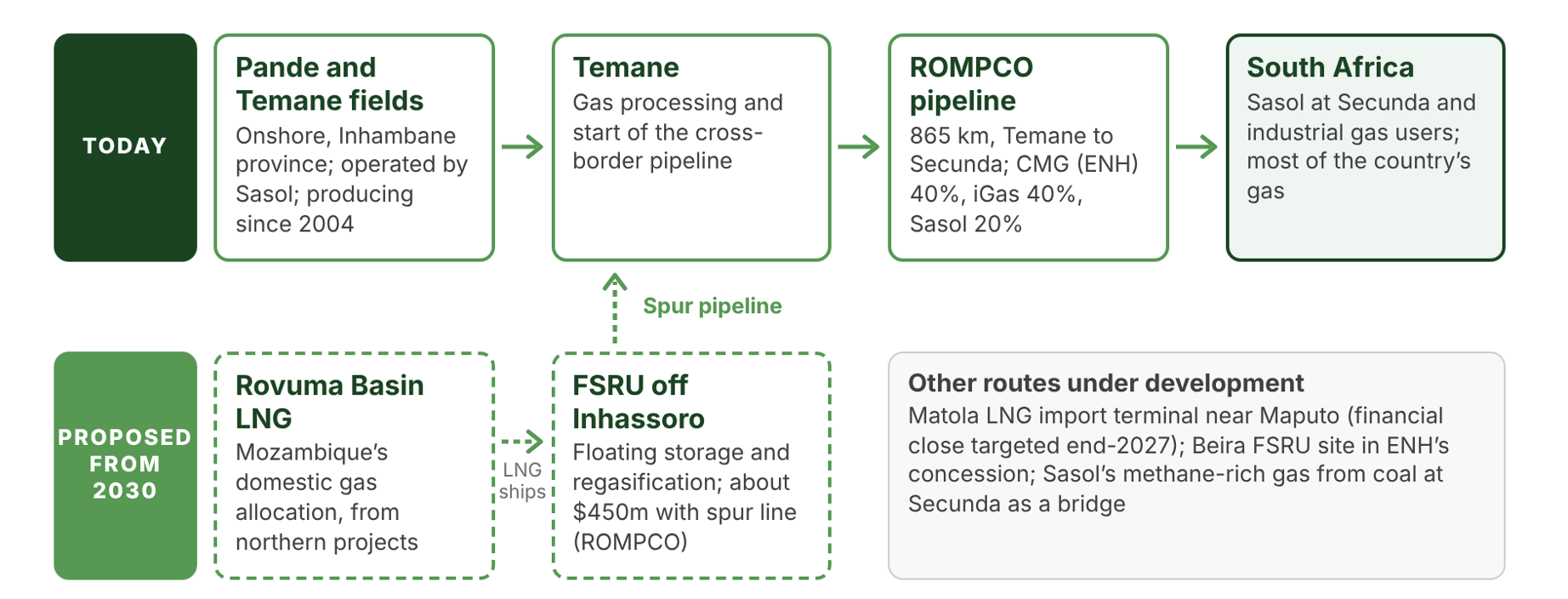
Source: Club of Mozambique, Bloomberg, Ecofin Agency, Green Building Africa. The Inhassoro terminal is at feasibility stage; cost as cited by ROMPCO.
South Africa’s gas cliff
The urgency comes from South Africa. The Pande and Temane fields have supplied about 90% of South Africa’s gas for more than two decades, and supply is expected to begin falling after 2028, according to an analysis by Davies Tsikayi of the University of the Witwatersrand published in July. Industries that rely on the gas directly employ about 70,000 to 100,000 people, and alternatives such as LPG, diesel or electricity could cost two to five times what users now pay, before the cost of converting equipment.
South Africa also plans to burn more gas for power. Electricity and Energy Minister Kgosientsho Ramokgopa said on 7 October that 5,000 MW of gas-to-power and 4,600 MW of battery storage would be prioritised for procurement under the Integrated Resource Plan 2025. Bids for the first gas-to-power round closed on 29 May 2026, and preferred bidders had not been named when the minister spoke. Tsikayi estimates that the country may need 300 to 400 petajoules (PJ) of gas a year, equivalent to 6 to 8 million tonnes of LNG, for industry and power.
Other import routes are in development. Beluluane Gas Company is developing an LNG import terminal at the port of Matola, near Maputo, with financial close planned for the end of 2027, Ecofin Agency reported, and South Africa’s draft Gas Master Plan identifies Richards Bay as a key location for LNG imports. Speaking at the summit on 11 November, Prime Minister Levi said: “For Mozambique, natural gas represents not only an export opportunity, but also a strategic asset.”
KEY FACTS The Inhassoro LNG import project
| Project | FSRU-based LNG import terminal off Inhassoro, Inhambane province, with a spur line to the ROMPCO pipeline at Temane; ENH’s concession also covers the Port of Beira |
| Agreements | Sasol–ENH MoU on feasibility (11 Nov 2026); ROMPCO–ENH MoU on due diligence and a possible joint-development agreement (12 Nov 2026) |
| Cost | About $450 million (ROMPCO, via Bloomberg); about $250 million (ENH estimate, October 2026) |
| Timing | Joint-development agreement targeted by January 2027; commissioning expected from 2030 |
| LNG source | Mozambique’s domestic gas allocation (25% domestic market obligation, extended to LNG in June 2026) |
| Project company | SLIGM, formed in April 2026 by ENH, EDM, CFM and HCB |
| ROMPCO pipeline | 865 km, Temane to Secunda; CMG (ENH) 40%, iGas (South Africa) 40%, Sasol 20% |
Sources: Club of Mozambique, Bloomberg, Ecofin Agency, Green Building Africa, Reuters, as reported.
MILESTONES From MoU to first gas
| Date | Event |
| 2004 | Gas production from Pande and Temane begins under the Petroleum Production Agreement |
| April 2026 | ENH, EDM, CFM and HCB form SLIGM to develop the terminal |
| June 2026 | Mozambique extends its 25% domestic market obligation to LNG |
| August 2026 | Government awards FSRU concession for Beira and Inhassoro |
| 7 October 2026 | South Africa prioritises 5,000 MW of gas-to-power and 4,600 MW of storage |
| 11 and 12 November 2026 | Sasol and ROMPCO sign MoUs with ENH in Maputo |
| January 2027 | Target for ROMPCO–ENH joint-development agreement |
| End-2027 | Target for financial close of the Matola LNG import terminal |
| After 2028 | Pande-Temane supply expected to begin to decline |
| From 2030 | Inhassoro FSRU commissioning expected |
Future dates are targets stated by the companies or expectations reported by analysts.
Analysis
The agreements matter because they put the two companies that already run the Mozambique–South Africa gas chain behind ENH’s terminal. ROMPCO owns and operates the cross-border pipeline and Sasol operates the fields that feed it, so their backing gives the project a route to market that a stand-alone terminal would lack. Both MoUs are, however, preliminary. ROMPCO’s first task is due diligence, and the binding steps, a joint-development agreement, a bankable feasibility study and a final investment decision, are still ahead.
Timing is the main risk. If Pande-Temane supply starts to fall after 2028 and the Inhassoro FSRU is commissioned from 2030, South Africa faces a gap of up to two years that will have to be covered by Sasol’s coal-derived methane, lower demand or another import route such as Matola. Boyce’s comment that FSRU developers need to move quickly reflects how little room there is for delay.
Price is the second issue. Sasol chief executive Simon Baloyi warned in 2024 that LNG bought on spot markets could cost end users three to five times more than current gas. Sourcing LNG from Mozambique’s domestic allocation is designed to bring the price below international levels. How that LNG is priced, and how much of it Mozambique’s own power and industrial projects take, will decide how much reaches South Africa and at what cost.
The project also links Mozambique’s Rovuma Basin LNG, built mainly for export, to regional demand. With TotalEnergies’ Mozambique LNG targeting first exports in 2029 and ExxonMobil’s Rovuma LNG awaiting a final investment decision, Maputo is positioning domestic LNG as a source of supply for Southern Africa as well as a source of revenue, in line with the Prime Minister’s description of gas as a strategic asset.
Investor Outlook
- FSRU owners and developers: A joint-development agreement in January would open the way to procurement of an FSRU and the spur line. ROMPCO’s interest in owning the spur and a stake in the FSRU points to roles for vessel owners and financiers as partners.
- Sasol: Securing gas beyond the Pande-Temane plateau is central to its South African operations. The MoU gives it a technical role; Sasol said in October that it was premature to speculate on the nature or scale of any investment.
- South African gas users: With commissioning from 2030, industrial users should plan for the period from 2028, including bridge supply, fuel switching and efficiency measures.
- Gas-to-power bidders: Gas delivered through existing pipeline infrastructure at below international LNG prices would support inland gas-to-power under the 5,000 MW programme, but supply contracts will need to match plant timelines from 2030.
- Watchpoints: Signing of the ROMPCO–ENH joint-development agreement; feasibility study results and a confirmed cost; the pricing of Mozambique’s domestic LNG; financial close at Matola; and the naming of preferred bidders in South Africa’s first gas-to-power round.
Cost estimates differ between sources, and the project has not reached a final investment decision. This article is provided for information purposes only and does not constitute investment advice.