Woodside’s share of oil from Senegal’s Sangomar field fell to 73,000 barrels a day in the third quarter, from about 86,000 in the second, after it recovered all the pre-investment costs it had funded. That leaves a larger share for Petrosen and the state even as total output slipped to 94,000 b/d. With the field now in decline, Woodside is weighing a six-to-eight-well second phase, while Dakar cuts its 2027 energy ministry budget by 48% amid a debt crisis.
| 94,000 b/d
Sangomar output in Q3 2026, down from 99,000 b/d in Q2 |
22%
Share of output now going to Petrosen and the state, up from about 13% (AER calculation) |
6 to 8
Wells under evaluation for a Sangomar second phase |
Senegal is receiving a larger share of the oil from its Sangomar field as production passes its peak. Woodside Energy’s third-quarter report, published on 21 October 2026, shows that the field averaged 94,000 barrels per day on a 100% basis, down from 99,000 b/d in the second quarter, which Woodside attributed to natural field decline. Woodside’s own share fell faster, to 73,000 b/d or 78% of output, because it has now recovered 100% of the pre-final investment decision costs it funded, reducing its net entitlement under the production sharing contract.
Woodside’s Sangomar production fell 14% quarter on quarter to 6.76 million barrels, and its revenue from the field fell to $659 million from $763 million, bringing the nine-month total to $1.95 billion. On AER’s calculation from Woodside’s figures, the share of output going to Petrosen, which holds 18%, and to the state rose from about 13,000 b/d, or 13% of production, in the second quarter to about 21,000 b/d, or 22%, in the third. Operational reliability remained high at 99.2%.
Senegal’s Ministry of Energy and Petroleum said in its monthly report, published on 9 October, that the production plateau had begun to turn down. The field shipped 2.94 million barrels in three cargoes in September, against 3.8 million barrels in January. Woodside chief executive Liz Westcott said in August that the field had entered its decline phase while continuing to perform strongly.
Phase 2 under discussion
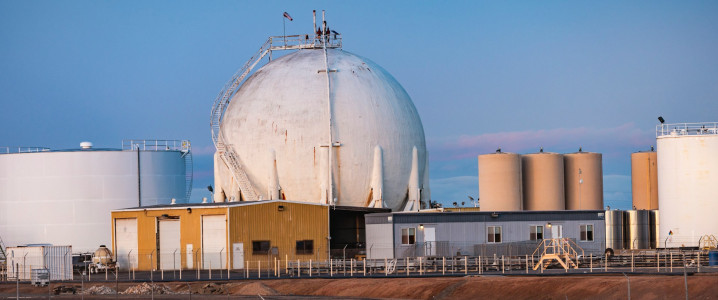
Woodside and Petrosen are discussing a second phase to slow the decline. PressAfrik reported on Wednesday, 11 November, that according to Woodside documents the plan would evaluate the field’s upper S400 reservoirs and could involve six to eight wells using the existing floating production vessel, the FPSO Léopold Sédar Senghor, which has a capacity of 100,000 b/d. Petrosen Director General Thierno Seydou Ly told AFP on 1 October that Senegal hoped to enter the second phase around 2028 with about eight additional wells, and that the investment cost would become clearer shortly. No final investment decision has been taken.
At a meeting with Woodside in June, Energy and Petroleum Minister El Hadji Abdourahmane Diouf said future negotiations should address technical, fiscal, contractual and gas issues in a single framework, with the best use of national gas a priority. Sangomar, operated by Woodside with an 82% interest, started production in June 2024 and reached its 100,000 b/d capacity within nine weeks.
CHART Sangomar output and who gets it (thousand barrels per day)
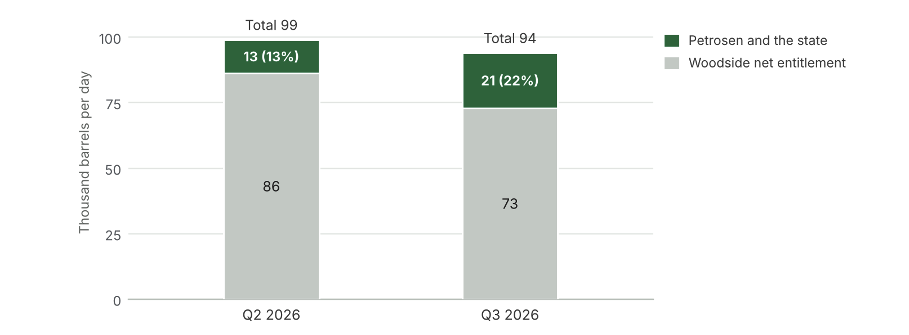
Source: Woodside Third Quarter Report 2026 (gross output and Woodside share); Petrosen and state share calculated by AER as the difference.
KEY FACTS Senegal’s oil and gas projects at a glance
| Sangomar | Woodside 82% (operator), Petrosen 18%; first oil June 2024; FPSO capacity 100,000 b/d |
| Q3 2026 output | 94,000 b/d (100% basis), down from 99,000 b/d in Q2 |
| Woodside share | 73,000 b/d, or 78.01% of output, after full recovery of pre-FID costs |
| Woodside revenue | $659 million in Q3; $1.95 billion in the first nine months of 2026 |
| Sangomar Phase 2 | Six to eight wells targeting upper S400 reservoirs; Petrosen hopes to start around 2028 |
| GTA LNG (with Mauritania) | 27 cargoes in the first nine months; 32 to 36 expected in 2026 |
| Yakaar-Teranga | About 25 tcf recoverable; about $7.5 billion to develop; Petrosen seeking partners |
| Open acreage | 104 oil and gas blocks available to investors |
Sources: Woodside, Kosmos Energy, Petrosen, Ministry of Energy and Petroleum, as reported. The Petrosen and state share is an AER calculation.
Gas, acreage and a tighter budget
Senegal’s gas output is holding up. Kosmos Energy reported that the BP-operated Greater Tortue Ahmeyim (GTA) LNG project, which Senegal shares with Mauritania, lifted 8.5 cargoes in the third quarter and 27 in the first nine months, and expects the year to end at the top of its guidance of 32 to 36 cargoes. The onshore Northern Segment of Senegal’s gas pipeline network, which will link the GTA hub to the 230 MW Gandon power plant, was more than 25% complete in October.
Petrosen took full control of the Yakaar-Teranga gas project, with about 25 trillion cubic feet of recoverable resources, after Kosmos withdrew in April, and puts its development cost at about $7.5 billion. Senegal is looking for partners and has 104 oil and gas blocks open to investors, Diouf told African Energy Week in Cape Town on 15 October. “Capital must earn a return. Senegal must gain a stronger economy. The partnership we seek must serve both purposes,” he said.
The upstream push comes as public finances tighten. Senegal’s draft 2027 budget cuts payment appropriations for the energy ministry by 48%, to 64.2 billion CFA francs from 123.3 billion, Pi Business Info reported on 11 November; most of the remaining spending goes to universal electricity access. The government reached a staff-level agreement with the IMF on a $2.2 billion programme on 1 September, which still awaits Board approval, and the National Assembly has since rejected proposed revisions to the 2026 budget by 109 votes to 20. Moody’s rates Senegal Caa2 and S&P rates it CC.
Analysis
The shift in entitlement is the most immediate effect for Senegal. Production sharing contracts front-load returns to the contractor through cost recovery; once those costs are recovered, a larger share of each barrel goes to the state and its national oil company. That partly offsets the fall in volumes and comes when Senegal needs revenue, although the cash the treasury receives will also depend on oil prices and on how the state’s share is sold.
The second phase is now the key variable for the field’s output. Using the existing FPSO would keep costs down, and targeting shallower reservoirs could slow the decline that both the operator and the ministry now acknowledge. The timing of a decision depends on agreeing terms acceptable to both sides, and Senegal has said it wants to negotiate technical, fiscal, contractual and gas issues together.
Gas is Senegal’s longer-term growth story. GTA is performing at the top of its guidance, the domestic pipeline is under construction and Yakaar-Teranga, at about 25 tcf, is large enough to anchor gas-to-power and industry. But the state must now attract partners for a $7.5 billion project while its budget is under pressure and it negotiates with the IMF and its creditors.
For investors, Senegal is signalling openness: 104 blocks are available, Eni has signed an agreement to assess five offshore blocks, and the government says it wants partnerships that earn a return. The risks are fiscal. Delays to the IMF programme, sovereign ratings deep in speculative grade and budget pressure could push the state to seek better terms on new and existing projects.
Investor Outlook
- Woodside: Sangomar remains a highly reliable, cash-generating asset, but lower net entitlement and natural decline will reduce its contribution unless the second phase proceeds.
- Petrosen and the state: A larger entitlement supports oil revenue into 2027 and partly offsets lower volumes; how much reaches the budget depends on oil prices and the timing of liftings.
- Gas investors: Yakaar-Teranga is the main opportunity for new partners. Fiscal terms, gas pricing and offtake for power and industry will decide whether it is bankable.
- Explorers: With 104 open blocks and Eni assessing five offshore blocks, more licensing activity is likely ahead of MSGBC Oil, Gas & Power in Dakar on 1 to 3 December.
- Watchpoints: IMF Board approval and creditor talks; the ministry’s monthly production reports; a Phase 2 cost estimate and decision timeline; partner selection for Yakaar-Teranga; and progress on the pipeline to the Gandon power plant.