With Eni and TotalEnergies completing their exits from the former Shell joint venture on 26 and 27 October, three of the five big joint ventures that built Nigeria’s onshore and shallow-water oil industry have passed from the international majors to Nigerian companies. The majors are now concentrated in deepwater. AER maps the major fields, the leases that hold them and the companies that run them.
| 3 of 5
Big onshore and shallow-water joint ventures that have passed from the majors to Nigerian companies |
Over 50%
Share of national oil and gas output controlled by indigenous operators, per the Presidency (Feb 2026) |
37.01bn
Barrels of oil and condensate reserves at 1 January 2026, down 0.74% (NUPRC) |
Nigeria’s oil map has been redrawn. On Monday, 26 October 2026, Eni closed the sale of its Nigerian unit AENR, which held 5% of the former Shell Petroleum Development Company (SPDC) joint venture, to Apex, owned by Sterling Oil. On Tuesday, 27 October, TotalEnergies closed the $800 million sale of its 10% interest to Vaaris. The joint venture, operated since March 2025 by Renaissance Africa Energy, is now owned by NNPC and Nigerian private companies, although TotalEnergies keeps its economic interest in three gas licences that supply Nigeria LNG.
The two deals complete a sequence that began in August 2024, when Oando bought Eni’s Nigerian Agip Oil Company (NAOC), and continued in December 2024, when Seplat Energy completed its purchase of ExxonMobil’s shallow-water business, Mobil Producing Nigeria, and in March 2025, when Shell sold SPDC to Renaissance. Of the five big joint ventures through which the majors produced oil onshore and in shallow water, only the Chevron- and TotalEnergies-operated ventures are still run by a major. In February 2026, Olu Verheijen, Special Adviser to the President on Energy, said indigenous operators now control over 50% of national oil and gas production.
The majors have not left Nigeria; they have moved offshore. Shell raised its stake in the deepwater Bonga field to 65% in November 2025 and is developing Bonga North. ExxonMobil, which operates the Erha and Usan fields, announced a $1 billion infill drilling project at Usan with its partners in July 2026. Chevron still operates the Agbami field and its onshore joint venture, and Eni still operates Abo, Nigeria’s first deepwater field. This guide sets out who runs what.
How a Nigerian oil lease works
Almost all of Nigeria’s oil comes from areas held under Oil Mining Leases (OMLs), the production leases created by the Petroleum Act of 1969. Under that system a company surveyed under an Oil Exploration Licence (OEL), explored and drilled under an Oil Prospecting Licence (OPL) and, after a commercial discovery, produced under an OML, granted for up to 20 years and renewable. According to NUPRC data cited by Africa Check, 113 OMLs had been allocated by the end of 2018, across land, swamp and sea.
The Petroleum Industry Act (PIA), signed in August 2021, replaced these with Petroleum Prospecting Licences (PPLs) and Petroleum Mining Leases (PMLs), administered by the Nigerian Upstream Petroleum Regulatory Commission (NUPRC). Conversion is gradual. The NNPC/Chevron joint venture converted five OMLs into four PPLs and 26 PMLs in September 2024; Seplat converted its onshore OMLs 4, 38, 41 and 53 with effect from 1 January 2026; and TotalEnergies’ deepwater OML 130 is now PML 2, 3 and 4. Under regulations issued in February 2026, an OML can be renewed as a PML only at the end of its term, so the familiar OML numbers will remain in use for years.
The state’s share is held by NNPC Limited. In the onshore and shallow-water joint ventures, NNPC owns 55% or 60% alongside private partners, one of which operates the assets. In deepwater, companies work under production sharing contracts with NNPC as concessionaire. NNPC’s upstream subsidiary, NNPC Exploration and Production Limited (NEPL, formerly NPDC), also operates some leases directly.
The deepwater giants
Nigeria’s deepwater fields, in water as deep as 1,700 metres, are produced through floating production, storage and offloading vessels (FPSOs). They remain the stronghold of the international majors.
TABLE The deepwater giants: who runs what
| Field (lease) | Operator and partners | First oil | Notes |
| Abo (OML 125) | Eni (operator, 85%) | 2003 | Nigeria’s first deepwater producing field; its original FPSO was sold by BW Offshore in 2023 and renamed Mayo Abo |
| Bonga (OML 118) | Shell (operator, 65%), ExxonMobil 20%, Eni 15% | 2005 | FPSO capacity 225,000 b/d; Bonga North tie-back (FID December 2024) to produce up to 110,000 b/d by 2030 |
| Erha (OML 133) | ExxonMobil (operator, 56.25%), Shell 43.75% | 2006 | FPSO design capacity 210,000 b/d |
| Agbami (OML 127/128) | Chevron (operator); partners include Famfa Oil, NNPC and Chappal Energies | 2008 | More than 1 billion barrels produced; Chappal bought Equinor’s 20.21% in 2024 |
| Akpo (OML 130) | TotalEnergies (operator); CNOOC, Sapetro, Prime 130, NNPC | 2009 | Lease converted to PML 2, 3 and 4 |
| Oyo (OML 120/121) | Licensed to Nigerian-owned Allied Energy, whose interest passed to CAMAC (later Erin Energy); Eni operated at start-up | 2009 | Erin Energy entered bankruptcy in 2018; FPSO Armada Perdana sold in 2019 and renamed Tamara Tokoni |
| Usan (OML 138) | ExxonMobil (operator); partners include Chevron, TotalEnergies and CNOOC | 2012 | FPSO capacity 180,000 b/d; $1 billion infill project targets about 40,000 b/d more |
| Egina (OML 130) | TotalEnergies (operator); same partners as Akpo | 2018 | FPSO capacity 200,000 b/d; about 77% of project work hours were performed in Nigeria |
Partner lists are not exhaustive; capacities are operator design figures. Sources: operators, NUPRC, Offshore Technology, JPT, Rigzone, Business Front.
The deepwater portfolio has been reshuffled among the majors rather than abandoned. TotalEnergies sold its 12.5% Bonga stake for $510 million in a deal completed in November 2025, with Shell taking 10% and Eni using its pre-emption right to take the remaining 2.5%. Equinor left Nigeria in December 2024, selling its Nigerian unit, which held 53.85% of OML 128 and a 20.21% unitised stake in Agbami, to Chappal Energies. ExxonMobil’s Usan project, announced at the NOG Energy Week in Abuja on 8 July 2026, marks its return to drilling in Nigeria after operations were suspended in 2016, according to NUPRC.
The joint ventures that changed hands
Onshore, in the creeks and swamps of the Niger Delta and on the shallow continental shelf, Nigeria’s oil has historically come from five big joint ventures between NNPC and the majors. Three have changed hands since August 2024.
CHART Who owns the five big onshore and shallow-water joint ventures (October 2026)
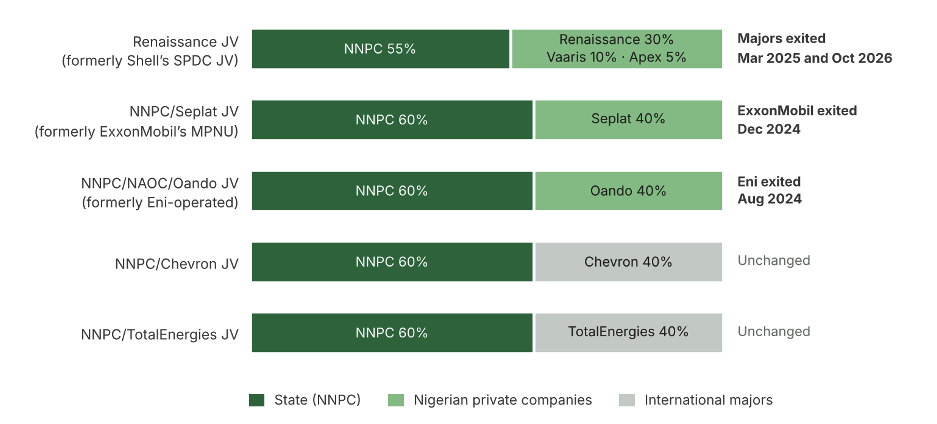
Source: Company announcements; AER research. TotalEnergies’ 10% sold to Vaaris covers 15 of the 18 licences; it keeps its economic interest in three gas licences (OMLs 23, 28 and 77).
TABLE The five joint ventures at a glance
| Joint venture | Operator | Main leases and assets | Change of control |
| Renaissance JV (formerly SPDC JV) | Renaissance Africa Energy | 18 onshore, swamp and shallow-water OMLs; Bonny and Forcados terminals; Trans Niger Pipeline; Sea Eagle FPSO | Shell sold SPDC, 13 Mar 2025; Eni and TotalEnergies sold their stakes, 26 and 27 Oct 2026 |
| NNPC/Seplat JV (formerly MPNU) | Seplat Energy | OMLs 67, 68, 70 and 104, shallow water off Akwa Ibom; Qua Iboe terminal; Yoho FSO | ExxonMobil sold Mobil Producing Nigeria, 12 Dec 2024 |
| NNPC/NAOC/Oando JV | NAOC, owned by Oando | OMLs 60, 61, 62 and 63 onshore; Brass River terminal | Eni sold NAOC to Oando for $783 million, 22 Aug 2024 |
| NNPC/Chevron JV | Chevron Nigeria | Onshore, swamp and shallow-water leases in the western Niger Delta; Escravos terminal | Unchanged; converted to PIA terms, Sept 2024 |
| NNPC/TotalEnergies JV | TotalEnergies EP Nigeria | OML 58 onshore; OMLs 99, 100 and 102 offshore | Unchanged |
NNPC holds 55% of the Renaissance JV and 60% of the others.
Renaissance Africa Energy, owned by ND Western, Aradel, First E&P, Waltersmith and Petrolin, operates 18 leases, the Bonny and Forcados export terminals and the Sea Eagle FPSO. Its chief production officer said in August 2025 that oil output had risen from about 100,000 b/d at handover to about 230,000 b/d, and the company is targeting 500,000 b/d of crude, and about 1 million boe/d in total, by 2030. On 7 July 2026 it announced a light-oil discovery at the JK-004 exploration well in OML 74, with about 1,000 feet of hydrocarbon-bearing column across seven reservoirs.
Seplat Energy, listed in Lagos and London, averaged 131,506 boe/d in 2025, up 148% after the Mobil acquisition, and guides 135,000 to 155,000 boe/d for 2026. Its 11 blocks include OMLs 4, 38 and 41, acquired in 2010; OML 53, bought from Chevron in 2015; OML 40, through its 2019 purchase of Eland Oil & Gas; and the four former Mobil leases. It operates the Qua Iboe terminal, the Yoho FSO and gas plants at Oben and Sapele, and has an interest in the ANOH gas plant.
Oando paid $783 million for NAOC and now holds 40% of the NNPC/NAOC/Oando joint venture, having bought ConocoPhillips’ 20% in 2014. Its upstream output rose 16% to 42,789 boe/d in the first half of 2026, with facility uptime of 92%, and it is targeting about 100,000 boe/d in the medium term.
Chevron and TotalEnergies remain onshore. NNPC’s then chief executive, Mele Kyari, said in September 2024 that Chevron had not considered fully exiting shallow-water production, as the NNPC/Chevron joint venture converted its leases to PIA terms with a target of 165,000 b/d. TotalEnergies has been selling elsewhere, leaving Bonga and the Renaissance JV, but still operates its own joint venture with NNPC and the OML 130 deepwater fields.
The Nigerian-run leases
Before the large corporate sales, Shell and its partners TotalEnergies and Eni sold their combined 45% of individual SPDC leases in several rounds from 2010, and Chevron sold 40% interests in some of its own. NNPC kept its share in each case. These sales created many of today’s mid-sized Nigerian producers.
TABLE Nigerian-held leases outside the big five joint ventures
| Lease | Nigerian holder | Since | Notes |
| OMLs 4, 38, 41 | Seplat Energy | 2010 | Seplat took over operatorship in July 2010; converted to PIA terms from January 2026 |
| OML 26 | First Hydrocarbon Nigeria | 2011 | Bought by an affiliate of Afren |
| OML 42 | Neconde Energy | 2011 | Batan, Egwa, Odidi and Jones Creek fields |
| OML 30 | Shoreline Natural Resources | 2012 | Bought with Heritage Oil; eight producing fields at acquisition |
| OML 34 | ND Western | 2012 | ND Western is also a Renaissance shareholder |
| OML 40 | Elcrest, now part of Seplat | 2012 | Seplat gained its interest through the 2019 purchase of Eland Oil & Gas |
| OML 53 | Seplat Energy | 2015 | 40% bought from Chevron; site of the ANOH gas plant |
| OMLs 83, 85 | First E&P | 2015 | 40% bought from Chevron; Anyala and Madu fields produce through the FPSO Abigail-Joseph (first oil October 2020) |
| OML 18 | Eroton and partners | 2015 | NNPC named NNPC Eighteen Operating Ltd as operator in March 2023; Eroton disputed the change |
| OML 29 | Aiteo (Nembe E&P) | 2015 | Bought with the Nembe Creek Trunk Line for $1.7 billion; contains Oloibiri, Nigeria’s first oil discovery |
| OMLs 71, 72 | West African E&P (Dangote 85%, First E&P) | 2015 | Kalaekule field began producing in December 2025 |
| OML 17 | Heirs Energies | 2021 | Bought for $1.1 billion |
| OML 11 | NNPC E&P (operator) | 2021 | Court of Appeal ruled SPDC could not renew the lease; Ogoniland output shut since 1993 |
| Marginal fields | Waltersmith (Ibigwe), Aradel (Ogbele), Frontier Oil (Uquo), Green Energy (Otakikpo) | Various | Smaller fields farmed out of larger leases; Otakikpo, in OML 11, has produced since 2017 |
Buyers of former Shell leases hold 45% and of former Chevron leases 40%, with NNPC holding the balance. OML 18 is held 55% by NNPC, 27% by Eroton, 16.2% by Sahara Group and 1.8% by Bilton.
Several of these companies are now significant producers. Aiteo’s operating subsidiary, Nembe E&P, said in July 2025 that OML 29 output had risen from about 25,000 b/d to about 90,000 b/d in a little over a year, and it is targeting 200,000 b/d. Heirs Energies says it lifted OML 17 output from about 27,000 b/d at takeover in 2021 to about 50,000 b/d within 100 days, and it is targeting 100,000 b/d. First E&P, which operates OMLs 83 and 85, also operates OMLs 71 and 72 for West African E&P and is a shareholder in both ND Western and Renaissance.
OML 11 and Ogoniland
OML 11, which covers Ogoniland, did not pass to Renaissance with the rest of the SPDC portfolio. Production in Ogoniland has been shut since 1993, when protests over environmental damage halted Shell’s operations. In August 2021 the Court of Appeal ruled that SPDC was not entitled to renew the lease, overturning a 2019 ruling, and NNPC said its upstream subsidiary had taken over the assets; Shell appealed. NNPC Exploration and Production is the operator.
Efforts to restart production are under way but unresolved. NNPC Group Chief Executive Bayo Ojulari visited Ogoniland in December 2025 as part of a federal re-entry programme that includes jobs, roads and environmental commitments; Ogoniland is reported to hold more than 40% of the block’s recoverable reserves. A financial and technical services agreement involving Sahara Energy and WAGL, a joint venture of NNPC and a Sahara affiliate, has been opposed by the Movement for the Survival of the Ogoni People (MOSOP) since December 2024, and in September 2026 Ogoni diaspora, youth and civil society groups said they would reject a restart on present terms. Other parts of the lease do produce: the Otakikpo marginal field, operated by Green Energy International, has been producing since 2017.
From wellhead to tanker
How crude reaches export depends on the terrain. Onshore, trunk pipelines carry it from flow stations to coastal terminals; in shallow water, it moves by pipeline to a terminal or to a floating storage and offloading vessel (FSO); in deepwater, it is processed and stored on an FPSO and loaded directly onto tankers.
EXPLAINER From wellhead to tanker: how Nigerian crude reaches export
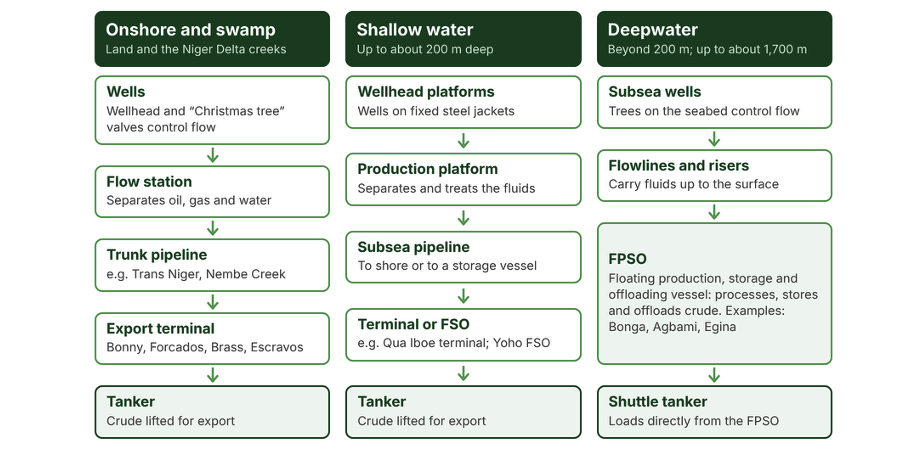
Source: AER. Simplified; terminals and vessels named are examples.
The floating fleet has become more Nigerian as well. Century Energy Services, part of Ken Etete’s Century Group, bought the Armada Perdana, which had served the Oyo field, in 2019 and renamed it Tamara Tokoni. It also upgraded the Tamara Nanaye (formerly the Front Puffin, which served the Aje field) in Lagos in 2024 for the Kalaekule field in OML 72. The risks were shown in February 2022, when the Trinity Spirit, an FPSO serving the Ukpokiti field in OML 108 for Shebah Exploration and Production, exploded and sank with 10 people aboard.
TIMELINE Milestones in Nigerian oil
| 1956 | Shell D’Arcy, soon renamed Shell-BP, discovers oil at Oloibiri, in present-day Bayelsa State |
| 1958 | First crude exports, from Oloibiri |
| 1969 | Petroleum Act creates the OEL, OPL and OML licensing system |
| 1977 | NNPC is established |
| 1993 | Production in Ogoniland is halted |
| 2003 | Abo becomes Nigeria’s first deepwater producing field |
| 2010 | Local content law enacted; Seplat takes over OMLs 4, 38 and 41 |
| 2018 | Egina starts production |
| 2021 | Petroleum Industry Act signed; Court of Appeal ruling on OML 11 |
| 2022 | Crude output falls to 937,766 b/d in September; Trinity Spirit FPSO explodes |
| 2024 | Oando buys NAOC; Seplat buys Mobil Producing Nigeria; Equinor exits; Shell approves Bonga North |
| 2025 | Renaissance takes over SPDC; TotalEnergies leaves Bonga |
| 2026 | Renaissance discovery in OML 74; $1 billion Usan infill project; Eni and TotalEnergies leave the Renaissance JV |
Crude output excludes condensate.
Progress and pressure points
Nigeria’s resource base remains large but is not growing. NUPRC put oil and condensate reserves at 37.01 billion barrels on 1 January 2026, down from 37.50 billion two years earlier, while gas reserves rose 2.21% to 215.19 trillion cubic feet. Output has recovered from the 2022 crisis, when crude production excluding condensate fell to 937,766 b/d in September amid theft and pipeline shutdowns. It reached 1.56 million b/d in June 2026, the highest since April 2020, and was 1.53 million b/d in September (1.72 million b/d with condensate), above Nigeria’s OPEC quota of 1.5 million b/d for a fifth consecutive month. That remains well below NUPRC’s target of 2.5 million b/d for 2026.
Local capacity has grown. The Nigerian Oil and Gas Industry Content Development Act of 2010 pushed fabrication and services in-country: six of the 18 modules on the Egina FPSO were built and integrated in Nigeria, according to TotalEnergies.
The pressure points are familiar. Crude theft and pipeline vandalism remain the main threat to onshore output, especially on the trunk lines that feed Bonny. Spills and community grievances, most acutely in Ogoniland, limit access. Much of the onshore infrastructure is decades old. And the new owners must fund drilling under PIA terms, including contributions to host community trusts and decommissioning funds, while NNPC meets its share of joint-venture costs.
Analysis
The handover follows a clear risk logic. The majors have sold the assets where security, spills and community relations carry the highest operational and legal risk, and have kept or enlarged their positions offshore, where facilities are isolated from the Niger Delta’s pipeline networks and crude is loaded directly onto tankers. Shell’s shift from SPDC to a 65% stake in Bonga, ExxonMobil’s exit from shallow water alongside its renewed drilling at Usan, and Eni’s purchase of a larger Bonga stake while selling NAOC and AENR all follow that pattern.
The new owners inherit both the barrels and the burdens. Renaissance, Seplat, Oando and the other indigenous companies now account for most of Nigeria’s onshore and shallow-water output and a large share of the gas supplied to Nigeria LNG and domestic power plants. Early results are encouraging: Seplat’s output more than doubled in 2025 after the Mobil acquisition, Oando reports higher uptime, and Renaissance has made a new discovery in OML 74. But Renaissance’s plan to more than double crude output to 500,000 b/d by 2030, and similar ambitions elsewhere, will require sustained capital, secure evacuation routes and community consent that the majors themselves often struggled to obtain.
Governance is the less visible risk. Operatorship disputes, such as the contest over OML 18 since 2023 and the opposition to new arrangements on OML 11, show how quickly disagreements between partners can stall output. With NNPC relying on service and financing agreements with private partners to fund its share, the transparency of those arrangements will matter to investors as much as the geology.
For the government, the measure of success is output, not ownership. With indigenous operators already accounting for more than half of national production, the 2.5 million b/d target for 2026 and NUPRC’s ambition of 3 million b/d by 2030 now depend largely on Nigerian companies. Declining oil reserves mean they must also find new oil, which makes discoveries such as JK-004 and drilling commitments such as Usan more significant than their size suggests.
Investor Outlook
- Listed exposure: Seplat (Lagos and London), Aradel and Oando (both Lagos) offer listed exposure to the indigenous onshore story, and Aradel’s shareholding in Renaissance gives indirect exposure to the former SPDC assets. Renaissance, Heirs Energies, First E&P and most other operators are private, so their bonds, loans and any future listings are the routes to watch.
- Deepwater: Bonga North, the Usan infill project and ExxonMobil’s wider offshore plans point to steady demand for drilling, subsea and FPSO services through 2030.
- Midstream and services: Pipeline security, floating storage, gas processing and in-country fabrication are growth areas as indigenous operators push output higher.
- Risks: Crude theft, community disputes, operatorship conflicts, foreign-exchange liquidity and the cost of capital remain the main risks, and indigenous operators are generally more exposed to them than the majors were.
- Watchpoints: Renaissance’s progress towards its 2030 targets; any settlement on OML 11 and OML 18; Chevron’s and TotalEnergies’ intentions for their remaining onshore joint ventures; the pace of OML renewals into PMLs; and monthly NUPRC output against the 2.5 million b/d target.
Sources
NUPRC data via Brandspur (14 Oct 2026), Arise News (13 Jul 2026), Channels TV (2 Apr 2026) and ThisDay; Africa Check; Mondaq; BusinessDay (Sep 2024). Companies: Renaissance (7 Jul 2026); Seplat (23 Dec 2025); Rigzone (2 Mar 2026); Oando H1 2026 results; TotalEnergies; Eni; Shell (1 Dec 2011).
Deepwater: Rigzone (1 Dec 2025, Bonga); Offshore Magazine (Dec 2024, Equinor exit); JPT (11 May 2025) and Nairametrics (9 Jul 2026), Usan; Offshore Technology (Erha, Oyo, Otakikpo, Kalaekule); Business Front (Feb 2026, Abo); Maritime Executive (Feb 2022, Trinity Spirit).
Leases and operators: OGJ (25 Mar 2015); The Cable; SweetCrude Reports (2012, 2015; 23 and 28 Dec 2025; 11 Feb 2026); Proshare (Jul 2012); Hawilti (Mar 2023, OML 18); Radio Nigeria (Jul 2025, Nembe E&P); S&P Global (17 Apr 2026, Dangote upstream).
Ogoniland and vessels: Nairametrics (21 Aug 2021); Primetime Reporters (17 Dec 2024); Sahara Reporters (10 Sep 2026); BusinessDay (Sep 2019); The Sun (Oct 2024); Billionaires.Africa (10 Oct 2026); Energy Voice (Abigail-Joseph); ThisDay (11 Aug 2020, Oloibiri).
Ownership and operator details reflect public information as at 31 October 2026 and may change; partner lists are not exhaustive. This article is provided for information purposes only and does not constitute investment advice.