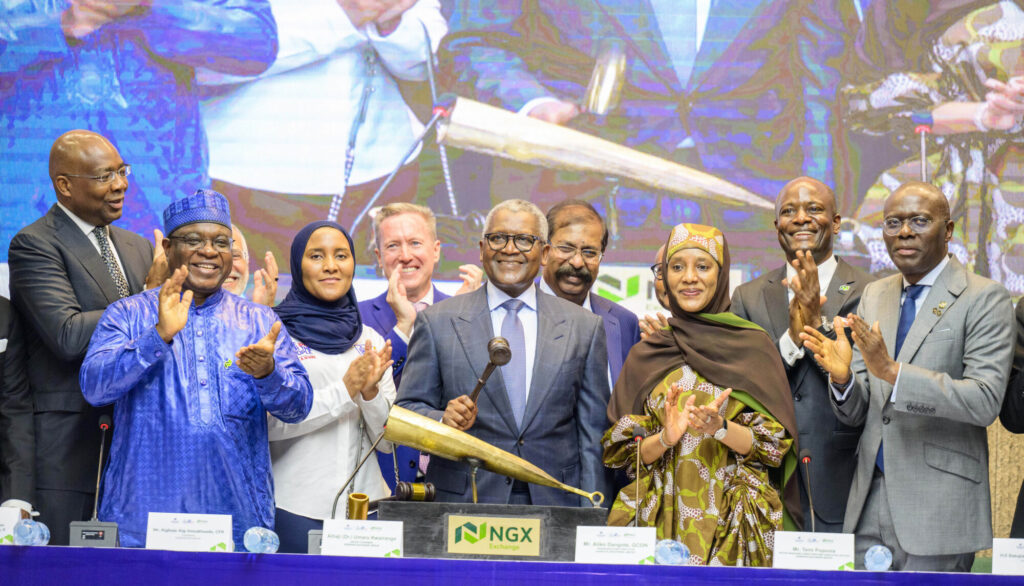
The African Export-Import Bank (Afreximbank) and the African Petroleum Producers’ Organization (APPO) formally established the Africa Energy Bank (AEB) at its inaugural General Meeting in Abuja on Saturday, 31 October 2026. Shareholders appointed Helmy Ghazi as the bank’s first President and constituted its first Board of Directors, completing a six-year process that began in Cairo in 2020.
| $5bn
Authorised capital of the Africa Energy Bank |
$200bn
Africa’s estimated energy investment needs, according to the founders |
18
APPO member countries, the bank’s founding constituency |
The Africa Energy Bank was formally established on Saturday, 31 October 2026, at its inaugural General Meeting in Abuja, Nigeria, where it is headquartered. In a joint statement, Afreximbank and APPO said the first General Assembly appointed Helmy Ghazi as the bank’s inaugural President and constituted its first Board of Directors, drawn from the public and private sectors and from leading policy institutions across the continent. The directors have not yet been named.
The bank has an authorised capital of US$5 billion. It is structured as an independent, supranational pan-African financial institution and will seek investment from governments, national oil companies, financial institutions and private investors. Its mandate covers the full energy value chain, including exploration and production, transportation, processing, refining and distribution.

“The creation of the Africa Energy Bank reaffirms African governments’ determination to secure their own energy future,” the two institutions said. They put the continent’s energy investment needs at US$200 billion, citing the investment in power generation and transmission required to support industrial growth and emerging technologies, notably artificial intelligence, at a time when traditional financiers are withdrawing from fossil fuels even though oil and gas remain vital to Africa’s energy systems. “The Africa Energy Bank aims to bridge this financing gap while supporting a just energy transition for African countries,” the statement said.
The founders said the bank would aim to strengthen productive capacity, reduce dependence on imported petroleum products, promote intra-African energy trade and expand African participation in the industry. The meeting was attended by Senator Heineken Lokpobiri, Nigeria’s Minister of State for Petroleum Resources (Oil); Dr George Elombi, President and Chairman of the Board of Directors of Afreximbank; and Mamadou Sangafowa-Coulibaly, Côte d’Ivoire’s Minister of Mines, Petroleum and Energy and APPO President for 2026.
The pioneer President
The joint statement did not include a biography of the new President. Nairametrics reported that Ghazi, an Egyptian banker with more than 25 years’ experience, was previously Deputy Chief Executive Officer and Managing Director, Head of Global Banking, at HSBC Bank Egypt. He takes office as the bank prepares to begin lending, which APPO said in June would open towards the end of 2026.
KEY FACTS The Africa Energy Bank at a glance
| Established | 31 October 2026, at the inaugural General Meeting in Abuja |
| Founders | Afreximbank and the African Petroleum Producers’ Organization (APPO) |
| Status | Independent, supranational pan-African financial institution |
| Headquarters | Abuja, Nigeria |
| Authorised capital | US$5 billion |
| Reported capital plan | US$1.5 billion from APPO’s 18 member countries (about US$83 million each); US$3.5 billion from Afreximbank, other African countries and investors |
| Start-up target | US$500 million, set by APPO in November 2025 |
| First phase | Up to US$10 billion of financing, initially in Nigeria, Angola and Libya |
| Mandate | Exploration and production, transportation, processing, refining and distribution |
| Leadership | President: Helmy Ghazi; first Board of Directors constituted, members not yet named |
The capital plan, start-up target and first-phase figures are as reported by APPO, Climate Home News and Further Africa; the founders’ statement of 31 October gives the authorised capital only.
Six years from concept to launch
The bank was conceived in Cairo in December 2020, when Egypt’s then Minister of Petroleum and Mineral Resources, Tarek El Molla, hosted Afreximbank and APPO. The two institutions signed a memorandum of understanding in May 2022, and on 4 June 2024 Afreximbank President Benedict Oramah and APPO Secretary General Omar Farouk Ibrahim signed the Establishment Agreement and Charter in Cairo, with an initial capital of US$5 billion. On 4 July 2024, APPO’s Council of Ministers chose Abuja as the headquarters on the recommendation of a ministerial committee chaired by Libya’s Minister of Oil and Gas, Mohamed Oun.
Under the structure reported in 2024, the bank has three classes of shareholders, with APPO and Afreximbank holding priority positions. Climate Home News reported in October 2026 that the plan envisages US$1.5 billion from APPO’s 18 member countries, at about US$83 million each, and US$3.5 billion from Afreximbank, other African countries and foreign investors, with an ambition to mobilise US$120 billion within five years. The first operational phase targets up to US$10 billion of financing, initially in Nigeria, Angola and Libya.
Nigeria, as host, had paid about US$69 million towards its equity in the bank by November 2024, ThisDay reported, and it handed over the headquarters building in February 2026 on the sidelines of the Nigeria International Energy Summit. “The headquarters is ready, strategically located, and fully equipped, and we are prepared for immediate take-off,” Lokpobiri said at the time.
The start date slipped several times. Nigeria first set 28 January 2025 for the bank’s take-off, and later targets in 2025 and 2026 were missed as members worked to raise start-up capital. In November 2025, APPO set a goal of mobilising US$500 million, a tenth of the authorised capital, to fund start-up operations and initial projects. In June 2026, APPO Secretary General Farid Ghezali acknowledged “several postponements” and set September as the date for the bank to become operational.
TIMELINE The road to launch
| Dec 2020 | Concept developed in Cairo, hosted by Egypt’s Ministry of Petroleum and Mineral Resources |
| May 2022 | Afreximbank and APPO sign a memorandum of understanding |
| 4 Jun 2024 | Establishment Agreement and Charter signed in Cairo, with US$5 billion initial capital |
| 4 Jul 2024 | APPO Council of Ministers selects Abuja as headquarters |
| Nov 2024 | Nigeria reports about US$69 million paid towards its equity; take-off set for 28 January 2025 |
| Nov 2025 | APPO sets a US$500 million start-up capital drive for 2026 |
| Feb 2026 | Nigeria hands over the Abuja headquarters |
| Jun 2026 | APPO resets the operational start to September 2026 |
| 31 Oct 2026 | Inaugural General Meeting establishes the bank and appoints Helmy Ghazi as President |
Sources: Daily News Egypt; African Energy Chamber; APPO Council communique; ThisDay; Ecofin Agency; Gazette Nigeria; Argus; Afreximbank.
Analysis
The establishment gives Africa’s oil and gas producers something they have sought since international lenders began withdrawing from fossil fuels: a dedicated, African-controlled financier for the whole hydrocarbon value chain. The timing is significant. In Nigeria, international majors have sold much of their onshore and shallow-water production to Nigerian companies since 2024, and the new owners need long-term dollar finance to raise output. Refining, gas processing and distribution projects intended to cut fuel imports face the same constraint.
CHART Capital, targets and need (US$ billion)
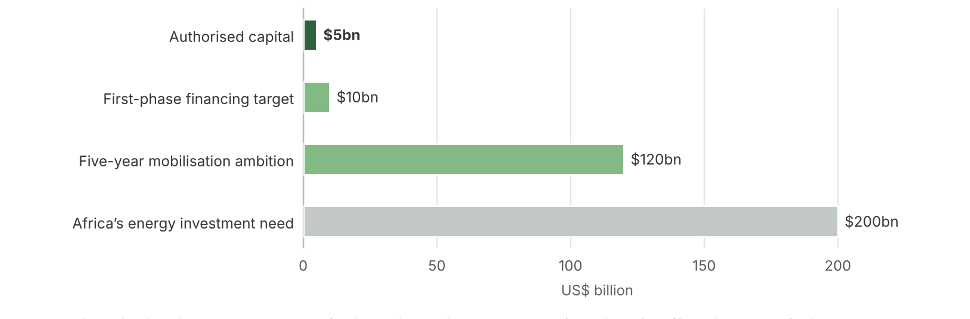
Source: Afreximbank and APPO joint statement (authorised capital, investment need); Further Africa (first-phase target); Climate Home News (five-year ambition).
The scale of the task is clear from the numbers. Authorised capital of US$5 billion is a fraction of the US$200 billion investment need the founders cite, and multilateral lenders typically pay in only part of their authorised capital. The bank’s impact will therefore depend on how much finance it can mobilise alongside its own balance sheet, through co-financing, syndication, guarantees and partnerships with commercial banks, pension funds and sovereign investors. The ambition of US$120 billion within five years implies mobilising about 24 times the authorised capital (AER calculation).
Credibility will rest on governance and capital discipline. Appointing a commercial banker as President, and a board that includes private-sector members, signals an intention to run the bank on commercial lines rather than as a channel for state funding. Investors will look for early disclosure of paid-in capital, the shareholder register, credit policies and environmental and social standards, and for a credit rating, which will determine the bank’s cost of funds.
The postponements since 2025 showed how difficult it has been to mobilise even start-up capital, and the bank’s focus on oil and gas has drawn criticism from climate campaigners. Its first transactions will test both concerns. A pipeline of bankable projects, timely capital payments by member states and co-financing from Afreximbank, which reported shareholders’ funds of US$9.0 billion at the end of September 2026, will be the clearest early signs that the bank can deliver on its mandate.
Investor Outlook
- Project sponsors: Upstream operators, gas processors, refiners and distributors gain a new potential source of long-tenor finance. Eligibility criteria, pricing and tenors, not yet published, will determine how the bank competes with commercial and trader-backed lending.
- Indigenous producers: African independents that have acquired assets from the majors, including Nigeria’s new onshore operators, are natural early clients, particularly for field redevelopment and gas monetisation.
- Banks and investors: Co-financing and syndication alongside the AEB and Afreximbank could give African lenders, pension funds and sovereign funds access to energy assets with multilateral participation.
- Member states: Capital subscriptions are a fiscal commitment for APPO governments and their national oil companies, and timely payment will be a key test of the bank’s credibility.
- Watchpoints: the names of the Board of Directors; paid-in capital and the shareholder list; the first approved transactions and the start of lending; a credit rating; and progress on the first-phase US$10 billion pipeline in Nigeria, Angola and Libya.
Sources
Afreximbank and APPO joint statement (31 Oct 2026); The Sun, Nairametrics, TheFact Daily and Zambia Monitor (31 Oct 2026).
Daily News Egypt and The Energy Year (June 2024); African Energy Chamber (16 May 2022); Ministry of Petroleum Resources, Nigeria (APPO Council communique, 4 Jul 2024).
ThisDay, via Kolaking (Nov 2024); Ecofin Agency (6 Nov 2025); Gazette Nigeria (3 Feb 2026); Further Africa (9 Feb 2026); Argus (5 Jun 2026); Climate Home News (9 Oct 2026).
Capital and shareholder details beyond the founders’ statement are as reported and have not been confirmed by the bank. This article is provided for information purposes only and does not constitute investment advice.