Energy Minister Juma Homera announced on Tuesday, 27 October 2026, an estimated 223 billion cubic feet of natural gas at the Kasa-1X ST2 well in the Mnazi Bay licence, operated by France’s Maurel & Prom with the Tanzania Petroleum Development Corporation. First gas could flow as early as November through existing infrastructure, although the operator’s own estimate is slightly lower and the volumes have not yet been classified as reserves.
| 223 bcf
Government estimate; the operator puts the find at about 200 bcf gross |
50 mmcf/d
Expected gross production potential, with first gas as early as November 2026 |
2015
Year of Tanzania’s previous natural gas discovery |
Tanzania has made its first new natural gas discovery in more than a decade. Energy Minister Dr Juma Zuberi Homera announced on Tuesday, 27 October 2026, at an event in Msimbati in Mtwara Region, that the Kasa-1X ST2 well in the Mnazi Bay licence had found an estimated 223 billion cubic feet (bcf) of gas. He described the find as a “major milestone for the country’s oil and gas sector” and said it would strengthen gas supply for power generation, industry, transport and households. It is the country’s first new gas discovery since 2015.
The licence is operated by Maurel & Prom (M&P), listed on Euronext Paris, which holds a 60% working interest. The state-owned Tanzania Petroleum Development Corporation (TPDC) holds the remaining 40% after doubling its stake from 20% in 2024, when it paid M&P $23.6 million under a new joint operating agreement that also gave it a larger role in decision-making.
What the operator reported
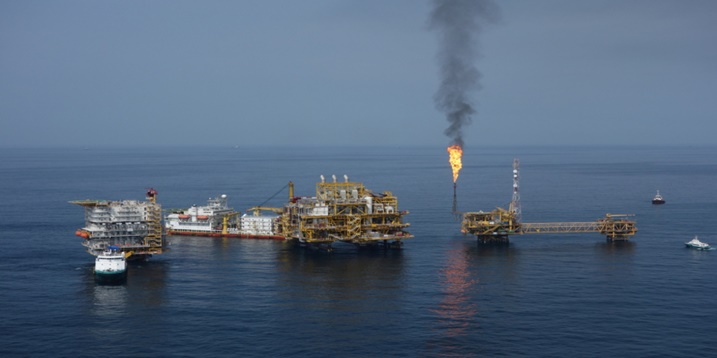
M&P first disclosed the result on 22 October in its activity report for the first nine months of 2026. It said the Kasa-1X exploration well, which began drilling in June, was drilled from the coast to a target about 4.5 km offshore in roughly 400 metres of water. The first penetration found gas, and the well was immediately sidetracked with a horizontal section that intersected 588 metres of reservoir. M&P said the well “confirmed the presence of a gas reservoir with encouraging characteristics” and estimated volumes at about 200 bcf gross, or 120 bcf net to its 60% interest. It expects first production as early as November 2026, with a gross production potential of about 50 million cubic feet per day (mmcf/d).
The government’s 223 bcf figure is higher than M&P’s estimate of about 200 bcf, and no public explanation has been given for the difference. Neither figure has been classified as gas initially in place, contingent resources or proved reserves, and no flow-test results have been published. Homera said the well should produce about 30 mmcf/d for at least 10 years, a more conservative rate than M&P’s stated potential.
Part of a three-well campaign
Kasa-1X was the exploration well in a three-well programme that also included two development wells, MB-5 and MS-2, drilled in the first half of 2026. Homera said the two development wells had raised output by more than 65 mmcf/d. M&P puts current Mnazi Bay production at about 130 mmcf/d gross (78 mmcf/d net to its interest), against an average of about 110 mmcf/d up to March 2026, according to the government’s 2026/27 budget statement. M&P said the combined potential of the existing wells is nearly 200 mmcf/d, while the field’s processing facilities have been tested at 150 mmcf/d.
For M&P, Tanzanian gas output net to its interest averaged 67.0 mmcf/d in the first nine months of 2026, up 12% on a year earlier, and its Tanzanian sales rose 62% to $63 million. The company reported group sales of $574 million for the period, up 17%.
CHART Mnazi Bay gas: output, well potential and processing capacity (mmcf/d, gross)
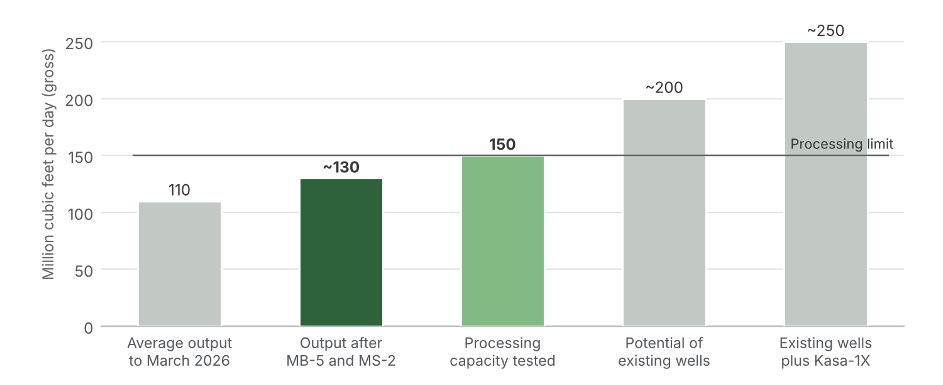
Source: Maurel & Prom activity report (22 Oct 2026); Tanzania 2026/27 budget statement via The Chanzo. Kasa-1X potential of about 50 mmcf/d added to existing well potential.
A field that feeds the power grid
Mnazi Bay is one of Tanzania’s two producing gas fields, alongside Songo Songo. A production sharing agreement was signed in 2004, M&P entered the licence in 2009, and a gas sales agreement with TPDC was signed in 2014. Since 2015, gas has been delivered from the Madimba processing plant through the 542 km Mtwara to Dar es Salaam pipeline. More than 80% of Mnazi Bay gas goes to power generation at plants operated by the state utility TANESCO in Mtwara and Dar es Salaam. In September 2024, when M&P announced an $80 million investment programme, recoverable reserves at the field were estimated at 641 bcf.
KEY NUMBERS The discovery at a glance
| Well | Kasa-1X, sidetracked as Kasa-1X ST2; drilled from the coast to a target about 4.5 km offshore |
| Reservoir intersected | 588 metres in a horizontal section |
| Estimated volume | 223 bcf (government); about 200 bcf gross, 120 bcf net to M&P (operator); not yet classified |
| Production | About 50 mmcf/d gross potential (M&P); about 30 mmcf/d for at least 10 years (minister); first gas as early as November 2026 |
| Licence partners | Maurel & Prom 60% (operator); TPDC 40% |
| Mnazi Bay output | About 130 mmcf/d gross now; processing tested at 150 mmcf/d |
| Context | About 35% of the field’s 641 bcf recoverable estimate (2024); about 0.4% of Tanzania’s 57.54 tcf of discovered gas |
Percentages are AER calculations using the government’s 223 bcf estimate.
Wider exploration push
The discovery comes as Tanzania tries to revive upstream activity. On Wednesday, 28 October, TPDC said the government had awarded it four exploration blocks: Mnazi Bay North, West Songo Songo, Eyasi-Wembere and Lindi-Mtwara. Seismic acquisition in Eyasi-Wembere and Lindi-Mtwara is due to be completed in December. At the nearby Ntorya field, a 35 km pipeline to Madimba was 70% complete in mid-October, with production of 40 mmcf/d expected from early 2027. TPDC is also in talks with four investors on small-scale LNG projects, three of them in Mtwara.
TPDC estimates Tanzania’s discovered gas at 57.54 trillion cubic feet (tcf) of gas initially in place, including 10.41 tcf onshore and 47.13 tcf in deep water. The deepwater gas underpins the proposed $42 billion Tanzania LNG project led by Equinor and Shell. Talks stalled in 2023 over fiscal and legal terms, but TPDC said in September that negotiations on commercial, fiscal and revenue-sharing terms were largely complete, and the government aims to finalise agreements in the coming months.
Analysis
The find is small by global standards but valuable at home. At 223 bcf it is equivalent to about 0.4% of Tanzania’s discovered gas, but to about a third of the 641 bcf of recoverable reserves estimated for Mnazi Bay in 2024. Its main advantage is speed and cost: the well was drilled from shore, and the gas can be processed at Madimba and moved through the existing pipeline to Dar es Salaam. First gas within months of discovery is rare in African gas, where most finds wait years for infrastructure.
The numbers still need to be firmed up. The government and the operator have given different volume estimates, neither has been classified under reserve standards, and no test data has been released. Investors should treat 200 to 223 bcf as a preliminary range until M&P books the volumes in its year-end reserves report. On a simple basis, 223 bcf would sustain 50 mmcf/d for about 12 years, or 30 mmcf/d for about 20 years, if it were all recoverable, which has not been established (AER calculation).
The constraint at Mnazi Bay is now infrastructure rather than resources. Existing wells can deliver nearly 200 mmcf/d and Kasa-1X could add 50 mmcf/d, but the processing facilities have been tested at only 150 mmcf/d, and Ntorya gas is due to enter the same Madimba hub from 2027. Unless processing and transport capacity are expanded, part of the new supply will be held back, so investment in midstream capacity is the next decision to watch.
The commercial risk lies with the buyer. With more than 80% of Mnazi Bay gas sold for power generation, revenue depends heavily on TANESCO’s ability to pay. Using common industry ratios of 4 to 5 megawatts per mmcf/d, 30 to 50 mmcf/d could support roughly 120 to 250 MW of gas-fired generation (AER estimate). The government’s plans to extend gas to industry, vehicles and households, and the small-scale LNG proposals in Mtwara, would widen the customer base and reduce that concentration.
Strategically, the discovery adds momentum at a useful moment. Together with the new blocks awarded to TPDC, the Ntorya development and the push to finalise Tanzania LNG, it signals that Tanzania is trying to restart an upstream sector that had seen no new gas discoveries since 2015. It does not change the economics of the deepwater LNG project, which depends on far larger volumes, but it supports the case that the country can bring gas to market quickly onshore and near shore.
Investor Outlook
- Maurel & Prom: Adds about 120 bcf net (on its own estimate) with near-term production through existing facilities. The key watchpoints are the first-gas date, the reserves classification at year-end and the realised gas price under its sales agreement with TPDC.
- TPDC and the state: With a 40% stake, TPDC gains directly from higher output. Its larger role in operations and four new exploration blocks increase its funding needs and its importance as a partner.
- Midstream and services: Processing capacity at Madimba and pipeline capacity to Dar es Salaam are the bottlenecks. Expansion, compression and small-scale LNG or CNG distribution offer opportunities for contractors and investors.
- Power sector: Additional gas supports grid reliability and could displace more expensive fuels, but payment security from TANESCO remains the main risk for upstream revenue.
- Watchpoints: the start of production from Kasa-1X in November; any explanation of the 223 bcf and 200 bcf figures; results from the new TPDC blocks; Ntorya first gas in 2027; and the final agreements on Tanzania LNG.
Sources
Maurel & Prom, nine-month 2026 activity release (22 Oct 2026); Drilling Contractor and OE Digital (Oct 2026); Capital.com (22 Oct 2026, M&P sales).
The Chanzo (28 Oct 2026); TanzaniaInvest (Oct 2026); Africanews (28 Oct 2026); The Citizen (27 Oct 2026); Daily News, Tanzania (19 Oct 2026).
Reuters, via CNBC Africa (28 Oct 2026, TPDC blocks); Africanews (15 Oct 2026, Tanzania LNG).
Discovery volumes are preliminary estimates and have not been classified as reserves. This article is provided for information purposes only and does not constitute investment advice.